Latest News
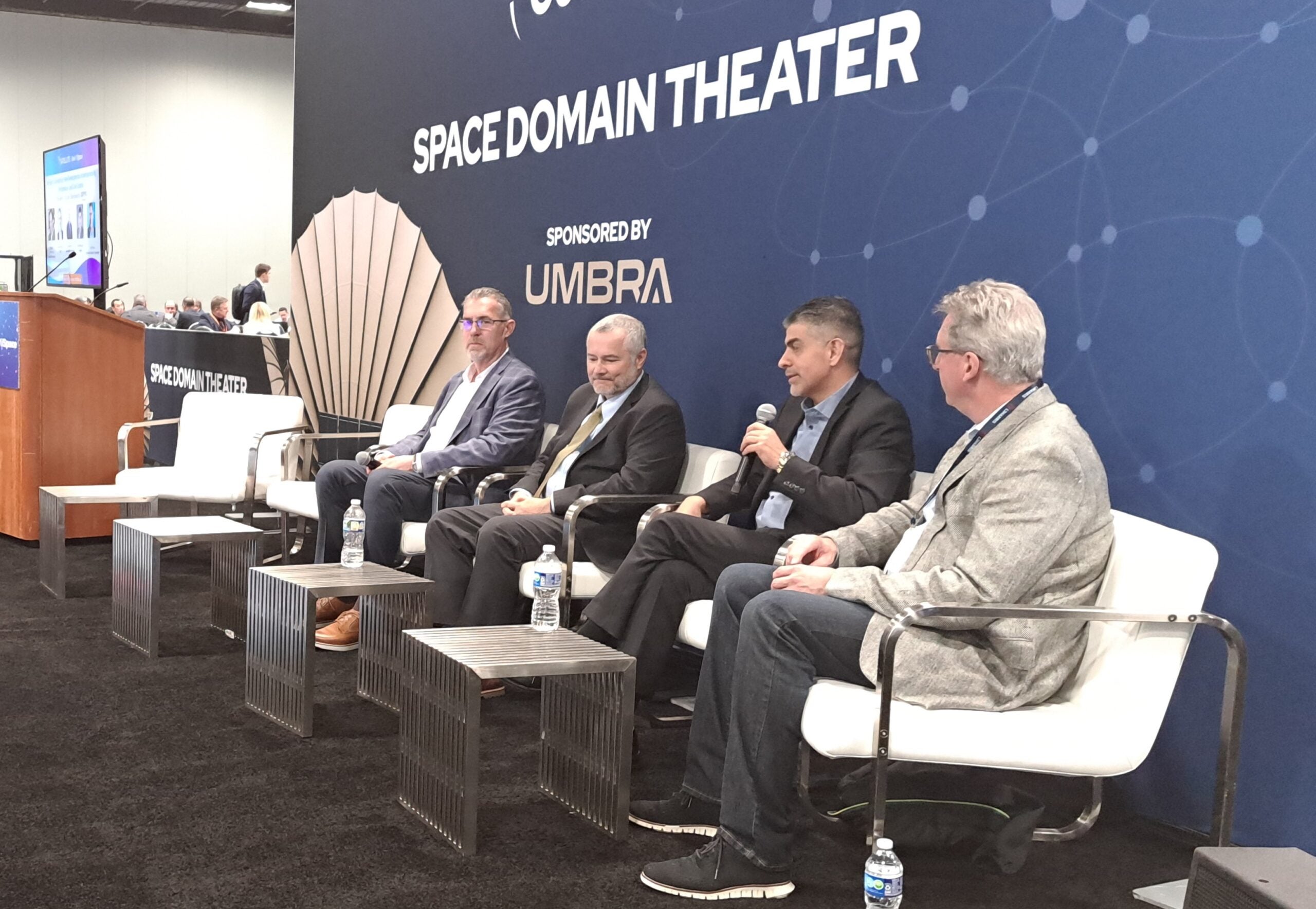
Photo: Via Satellite
Airlines have been embracing inflight connectivity (IFC) as a standard competitive offering for their passengers for over 20 years. But as the demand increases, IFC developers are diving deeper into the fact that IFC is more than just a customer amenity — it’s becoming a primary driver of multi-orbit architectures in an ongoing evolution of capabilities.
Interoperability has become a buzzword for inflight connectivity. But what does that mean today?
“This industry actually has been about interoperability for a lot longer than people realize, for the last 15-plus years in terms of the GEO systems,” said John Wade, vice president of Connectivity Services for Panasonic Aviation Corporation on Wednesday during SATShow Week. “There hasn’t been really a homogeneous single GEO network. So all of us have been putting together these different satellite networks and making it a seamless alliance.”
“Interoperability means advancing the seamlessness of getting equipment on board aircraft,” Mike Pigott, president, Gilat Stellar Blu said. “That equipment should last a long time on the aircraft, be upgradeable and be usable by multiple providers out there.”
He said that his company is building system designs that enable airlines to have less impact from the adoption and management of connectivity. “That’s how we can reduce their stress.”
Mike DeMarco, president of the Aero vertical of SES, said it comes down to having the right network in the right orbits to provide the right passengers the right connectivity from a passenger standpoint. “From there, it’s working with the airline,” he said. “It’s making sure you have the right digital experience in place and you’ve got the right portal, and working with them to figure out how they’re going to monetize connectivity.”
The SES network started as a GEO-only system, but has moved to both and LEO and GEO, DeMarco said. “As new capabilities have come online, we’re going to be moving and adding MEO into our network and moving to MEO and LEO constellations. We are looking to continue to layer in new orbits, and new partners as they come online, and just build upon the foundation that we have in space today.”
There is so much rapid change underway, Reza Rasoulian, senior VP of the Aviation group for Hughes Network Systems said, and airlines and owners of aircraft don’t want to have to replace the hardware over and over again in a small amount of time.
“Our philosophy is about providing ubiquitous connectivity at scale, but provide the flexibility to adapt, bring in new waveforms as the constellations evolve,” he said. “So our architecture is extremely open, leveraging technology that we built, leveraging partner technology, and really bringing a complete solution to the airline.”
The discussion shifted to revenue, and what CFOs care about. “Revenue is driven by the quality of inflight experience,” Rasoulian said. “It lends itself to a passenger wanting to travel on a particular airline. There’s a whole loyalty aspect that CFOs care about. If you have a very poor experience time and time again on a particular airline, you may want to select another airline. As time goes forward, it gets more and more nuanced. I think folks want to be connected seamlessly. They want a multi device experience. We can’t limit passengers anymore as an industry.”
Any new system in an airplane can be subjected to cyber security concerns. But for the most part, inflight connectivity systems are not the targets.
“That depends on the generation of the airplane, because cybersecurity, to my mind, has been an overstated as a risk for decades,” Wade said. “There is no physical connection between the communication systems we put on the airplanes and the avionics. There will be people reporting that they hacked into a system, but it’s not real.”
As we move into the more modern aircraft, he said, there is more potential for interconnection between their communication systems and the airplanes themselves. “It is an area we are all paying attention to, especially with the OEMs to make sure that there’s robust security,” Wade said.
Some aircraft manufacturers today are embedding connectivity provisions at the factory. “They are influencing the competitive dynamics of IFC suppliers in a large way,” Pigott said. “They’re looking at the industrialization of their activities. They want to push aircraft out of factories. And the easiest way to push aircraft out of factories is to have simple solutions on board while at the same time addressing customer needs. They are trying to find the balance.”
The process of inflight connectivity has made huge leaps in development, of both the equipment and the process of using it on an aircraft. “I started this industry over 25 years ago, and the fastest speed available to us on most airplanes at that time was 2.4 kilobits a second,” DeMarco said. “Here we are, just two decades later, on the cusp of introducing systems with gigabit size. This is a world that’s expanded dramatically. We’re not done with the evolution.”
Stay connected and get ahead with the leading source of industry intel!
Subscribe Now