Latest News
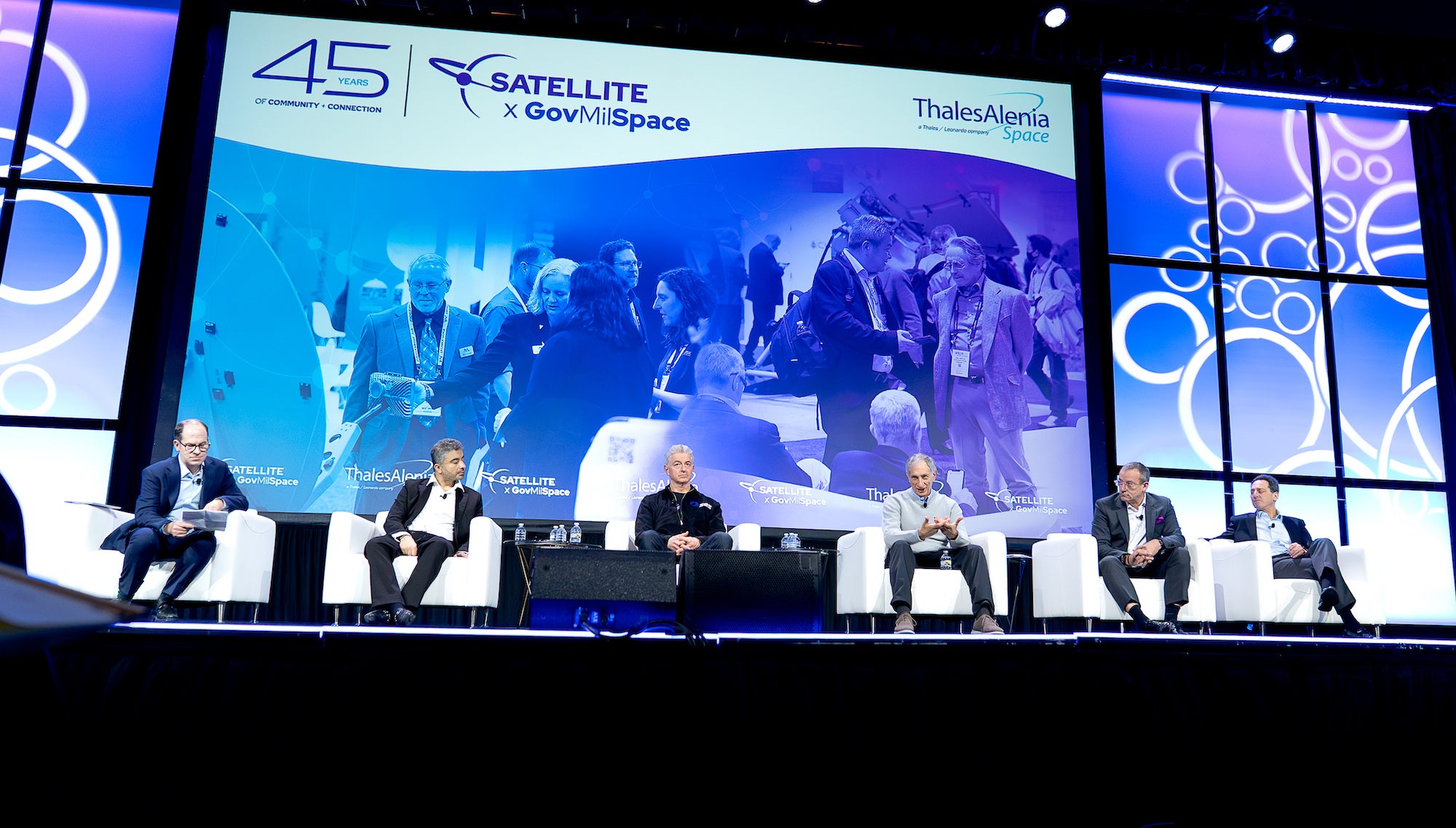
Satellite operator CEOs speak at SATShow Week 2026. Photo: Brooke Bryand Creative for Access Intelligence
With multiple active conflicts happening throughout the world and geopolitical concerns rising across the board, commercial satellite leaders say these developments put the importance of satellite communications in stark light – and put pressure on the industry to deliver.
“The geopolitical developments that we’re seeing are creating some of the biggest commercial opportunities for Telesat and the rest of us. It’s all of the increased defense spending [from the] NATO countries; it’s how the war has unfolded in Ukraine; and how consequential LEO satellite communications have been to that war; and some of the ruptures that we’ve seen around the world,” Telesat CEO Dan Goldberg said Tuesday during the Opening General Session of SATShow Week on March 24.
“It’s incumbent upon us to step up — to make the investments and provide the capabilities that are so needed right now,” Goldberg added.
To that end, Telesat recently announced it is making technology changes to the Lightspeed Low-Earth Orbit (LEO) constellation to add military Ka-band (Mil-Ka) spectrum to 156 satellites for defense and sovereignty programs. Goldberg noted this change dedicates 25% of the constellation’s capacity to Mil-Ka.
As the UAE is currently under threat from attacks by Iran, the geopolitical situation is top of mind for Ali Al Hashemi, CEO of Space Services for Space42. The company serves as the UAE’s space powerhouse, bringing together satellite communications, geospatial intelligence, and AI capabilities.
“When the geopolitical problem happened in the region, we were very glad that we took this step forward [to form Space42], because it enhanced our sovereignty and the applications that we deliver. It showed our resilience in the current situation,” Al Hashemi said.
Another way Space42 is focusing on UAE space sovereignty is Equatys, its joint venture for direct-to-device services with Viasat, which Al Hashemi noted puts the needs of sovereignty and independence as a top priority.
“We need to rethink everything. And Equatys is an example of rethinking the example of sharing the infrastructure, sharing the spectrum, and taking steps forward,” he added.
Viasat CEO Mark Dankberg was open about the threats that operators are responding to, which Viasat has a keen understanding of after the 2022 KA-SAT attack in Europe.
“If you look at geopolitical hot spots around the world, it’s not just the military systems that are being attacked. It’s the commercial ones as well, and we’re only seeing the very beginnings of those,” Dankberg said. “We’re seeing a need to rethink almost everything about the satellite industry. Different places around the world are grasping those realities at different paces. But you know, whenever there’s change, there’s opportunity.”
Dankberg noted this shift creates a particular opportunity for regional operators like Space42 that are closely tied in with their parts of the world.
“We’ve already always seen the overlap in requirements, how the underlying technology can serve both commercial and sovereign needs. Now, given the geopolitical realities, countries are realizing that they need more than what they’ve been buying before,” Dankberg said. “It certainly creates opportunities for regional satellite operators — they’re very closely tied to their governments and their region.”
A fractured geopolitical environment causes an impact to business models for global operators like SES, CEO Adel Al Saleh said. “Figuring out — how do you serve Europe, the U.S., Asia, and other markets is becoming a challenge for us,” he said.
A Push to Move Faster
One of the big takeaways from the discussion was that operators are speaking publicly about the need for changes in business models and the speed of technology.
“The speed of innovation continues to just accelerate,” Al Saleh said. “We can’t have five- to seven-year development cycles because of these announcements that keep coming. Whatever you design has to be flexible in a way that you’re able to upgrade it as you go forward. It’s no longer a five-year cycle.”
As an example of that change, SES on Tuesday shared more details about its meoSphere next-generation Medium-Earth Orbit (MEO) constellation, placing an initial order of 28 satellites from startup K2 Space. SES will provide its own software-defined payloads, and K2 Space will build out the high-power satellite platforms. SES said a series of pathfinders will launch over the next three years, and the meoSphere is targeted for operation by 2030
An SES representative confirmed to Via Satellite that SES has multiple payloads on the upcoming K2 Space “Gravitas” mission, which will be K2 Space’s first launch.
Dankberg described the current situation in the industry as “capital investment wars.”
“Satellite communications is one of the most capital intensive industries in the world. In an environment where you’re competing both economically and from a national security perspective — you need to aggregate capital in a way that is competitive with entities that have unlimited access to capital,” he said.
Eutelsat CEO Jean-François Fallacher sees interoperability and standards as one of the best ways that satellite operators can work together.
“I’ve been working for 30 years in the telecom industry. What struck me [about] the space industry and what my first wish would be is [to have] open standards, interoperability,” Fallacher said. “This is also a way to have more cooperation between actors that are around this table,” he added.
Telesat CEO Dan Goldberg said there’s room for improvement in how the technology providers work together, in terms of competing against vertically integrated players like Starlink and Amazon Leo.
“Telesat is still mostly in the mode where we’re a service provider and we’re procuring technology, satellites, user terminals from third parties. I think it puts us at a potential competitive disadvantage to our competitors who are vertically integrated. You pick up some things by not being vertically integrated, but, there’s some risks around that too,” Goldberg said.
“My number one request would be trying to find a way to align our interests so that we can all in the ecosystem remain competitive against these other companies out there that are vertically integrated,” he added.
Top Markets for Growth
The operator CEOs were polled in a rapid-fire round on the top markets they see for growth potential, here’s what they said.
Fallacher: ”We see a lot of tractions in commercial aviation, in the private jet aviation segment and also the maritime segment.”
Al Hashemi: “D2D is a big promise. We are simply creating our own supplier because we didn’t find the supplier who will offer this a seamless platform that can offer satellite operators an infrastructure-sharing platform.”
Al Saleh: “Aero is exciting. We don’t talk a lot about media. We love our media business. Yes, it’s declining, and yes, it’s challenged, but it is fundamentally strong and cash generative. The demand for real-time distribution of media like the Super Bowl and Olympics and PGA, Formula 1, is buoyant.”
Dankberg: “Commercial mobility. Because of the rise of autonomy, autonomous land vehicles, air vehicles, the mobility market is enormous. I think we have partnerships with every one of the operators up here in one form or another on mobility.”
Goldberg: “Something that is more obscure today, but is going to have growing importance in the future, is space-to-space communications, as we develop systems of systems and have more interoperability between constellations and different types of constellations.”
Stay connected and get ahead with the leading source of industry intel!
Subscribe Now