Latest News
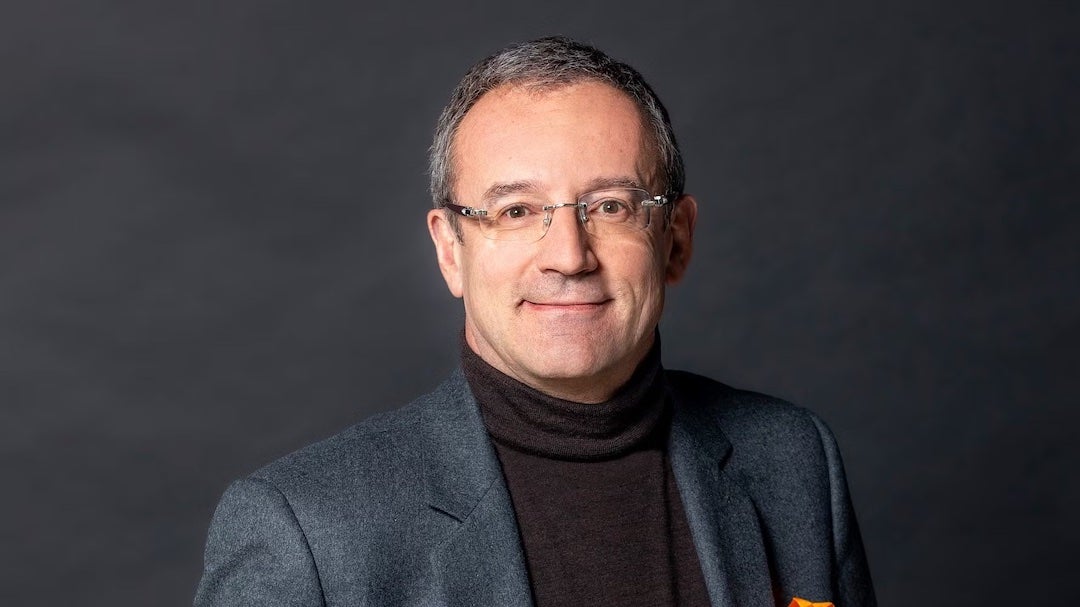
Eutelsat names Orange France CEO Jean-François Fallacher as CEO. Photo: Eutelsat
Eutelsat Group CEO Jean-François Fallacher has been in the job almost a year now. He has joined Eutelsat at an interesting time in its history as it looks to transform from a broadcast-heavy operator with Geostationary Orbit (GEO) assets to a more connectivity-based operator maximizing its assets in Low-Earth Orbit (LEO). With a mix of GEO and LEO assets, Eutelsat has an interesting place in the market.
After completing a large refinancing initiative, Eutelsat is set for an intense period as it looks to refresh its LEO satellites and bring new customers on board. Via Satellite catches up with Fallacher before SATShow Week to talk about the challenges and opportunities ahead for the company.
VIA SATELLITE: You have been in the job eight months now. What would you say have been your key learnings?
Fallacher: We have a fantastic team here, a very international team. We have a presence in many countries, in the U.K., France, Italy, and the U.S. We have a number of fantastic engineers and the drive energy of a startup. It was a great team coming from OneWeb with a bit of a different perspective.
I come from more than 30 years working in the classical telecom business. I was running a different number of affiliates of Orange in Europe in my career. Two things that really struck me is that in the space business, the need of anticipation is higher in the sense that when you do an investment, the time that your investment is really there, flying, delivering results and services is usually the order of magnitude is five years, which is much less in the classical telecom business.
Secondly, the second surprise for me was the fact that the technologies in the LEO business are very specific to each of the operators. There is no interoperability at this stage. There is no normalization of these technologies. These are not products you would find off the shelf.
VIA SATELLITE: You have a telecoms background similar to Adel Al-Saleh at SES. How is your perspective from the telecoms industry a benefit to leading a satellite operator?
Fallacher: There is a shift in the industry. The history of Eutelsat starts with video, GEO satellites. This is where we used to have a core business and this is still the case. It represents more than half of our business and a much larger part of our profits. This is the historical business and industry of Eutelsat. And then coming into the very high broadband service, delivering in 180 countries in the world with OneWeb where basically we are a provider of broadband access services.
This is exactly what a telecom operator is doing in country. We have the specificity to be very focused, to B2B customers, governments, large companies, versus Starlink for instance. This is the telecom business. This is why I believe the board chose me to lead it during this pivotal period where the company is transitioning from its classical business to be a new telecoms operator. A broadband telecom operator, which is covering the entire planet, not only 180 countries, but all the oceans as well as the air.
VIA SATELLITE: Eutelsat made headlines recently when it cancelled its FlexSat satellite, when you said the business case was ‘shaky.’ Do you expect to procure anymore GEO satellites now or will everything now be pretty much based on LEO and the OneWeb satellites?
Fallacher: We do obviously expect to procure some GEO satellites in the future, because the GEO business is still there. Although it is on a declining path. We have quite critical orbital positions where we expect we will invest further in the future.
But this specific one was actually not giving the expected return anymore. So, as we do for many of our investments, we are careful on the return of the key investments we are doing. We had the opportunity to drop this one.
We have another investment which is still ongoing — a satellite that we are doing in partnership with Thaicom, where delivery is scheduled in 2027. This is a one-time decision we took. But obviously we have one GEO still ongoing with Thaicom.
In the future, we will see at any given moment where we need to decide on investing in future GEO satellites. The FlexSat decision does not mark the complete end of us investing in GEO. On the contrary. let me remind that GEO is still, as we speak, 80% of our business. Again, this is slightly declining, and LEO, which is 20% of our business, is having huge growth.
VIA SATELLITE: How many GEO satellites might you order over the next five years?
Fallacher: That’s very complicated to answer. Today, we are running 31 GEO satellites. We have one in the making at this moment. I wouldn’t engage myself about the number, because we will also optimize what we are flying. It is pretty difficult to give a number of GEO satellites that in the coming five years, we will order, provision, and launch. There will be a number of opportunities, and the number of files we will look at this stage, especially before any decision is made.
VIA SATELLITE: What does the roadmap look like in terms of capital expenditure for satellites?
Fallacher: Let’s look at the financial side of side of our business. We have 1.2 billion euros ($1.4 billion) in revenues, and this has been more or less stable year-on-year. We have had the stability of our revenues in the in the first semester. We just had the results of the first [half], where we announced stability of revenues, and a slight decline of EBITDA. What we’ve been doing is completely refinancing the company for the coming five years. So, until 2030 we’ve had a capital increase that was awarded us by our key strategic shareholders and by the stock market to the total of 1.5 billion euros ($1.7 billion).
Immediately after, we actually raised an ECA of 1 billion euros ($1.1 billion), which covers our order of 440 new satellites with Airbus. That was executed in February and just recently, we closed a high yield bond issue.
If I look at what we also renewed as a bank debt, in total it is 5 billion euros ($5.8 billion) that we have been restructuring in a way to fully finance the company. We have done that precisely because we will need to invest roughly 1 billion euros every year, starting this year and in the coming two years. So, in total, 4 billion euros ($4.6 billion) in two trenches. The first tranche of 2 billion euros ($2.3 billion) is just to keep our current OneWeb constellation operational, and to improve from a number of operational aspects the characteristics of the satellites. So, this is the satellites we are getting to flight, the famous order of 440 new satellites plus 2 billion euros which is reserved for IRIS² post 2028-29.
VIA SATELLITE: How will Eutelsat OneWeb look to move more quickly with its OneWeb satellites to compete better with the likes of Starlink going forward?
Fallacher: We obviously learn from the past. The OneWeb project in 2015 has 10 years of experience. The constellation has been operational since 2022, so four years of operational experience. We have learned from the operations, and we are connecting and managing to correct a number of things and improve and strengthen the number of things on our satellites.
But it’s also about the ground, it’s about the user terminals, antennas, the complete system. The next step is we are working very hard on version two, the IRIS² project, alongside SES. We are looking to launch Gen 2 of our constellation. And now the name of the game for us is continue the growth we are having today.
At the moment, we have still room in our constellation outside the number of countries. Where we have almost entirely sold out the capacity, except, of course, what we reserve for aero. However, you will understand that in a country like Ukraine, we’re sold out. We are also sold out in Taiwan and in Saudi Arabia as well. Outside these geographies, we still have room of maneuver.
One of the things that struck me when I joined this business is the need to anticipate the need, three to five years ahead. By the time your satellites have been constructed, are launched, and join the system, it takes time. This is really deep tech. You know that the systems are extremely complex to run. And we are working daily to get faster, continue shooting for growth and improve our current generation of satellites.
VIA SATELLITE: How will the second generation of OneWeb satellites be different from the first? What changes are you making in the constellation?
Fallacher: We are constructing them alongside IRIS². They will be multi-orbit. So, the system is going to be MEO, LEO. That’s why SES is boarding in the project. We will have inter-satellite links. We will have also some very specific features for GovSat, for governmental and military satellites.
We will have also much more, digital features onboard the satellites. The Gen 2 we are working on alongside the IRIS² project. It will deliver overall more capacity. This is going to be the continuation of our current constellation, post-2030, so it needs to also procure to us what will be the case, the capacity to continue the growth path that we already engaged on.
VIA SATELLITE: Are you looking at vertical integration?
Fallacher: This moment, we are procuring our satellites with Airbus, our current generation. In terms of the second generation, we are in discussions with a number of providers, suppliers, to see how we are going to build this second generation.
At this stage, we want to stay an operator. However, like many, we are looking into this possibility. But for the moment, no such decision has been taken on the side of Eutelsat. We remain the operator of what is the only alternative to Starlink, and will remain the only European sovereign constellation in the future.
VIA SATELLITE: Is the number one growth opportunity right now for the company around European and sovereign defense strategies?
Fallacher: European strategic and sovereign defense is a priority. That’s clear. We’ve just signed last summer a 1 billion euro contract over 10 years with the French MoD. We’ve signed another contract also during last summer with the U.K. to actually connect all U.K. Foreign Affairs entities abroad. That’s definitely a strategic source of growth. This is linked to the fact that we are seen as a European sovereign constellation and an alternative to Starlink today or tomorrow’s American constellations. That is really putting clearly wind in our sails.
This is not only Europe. This is all across the world. We are having 180 countries where we have market access. And this constellation is servicing the entire planet. When I look at the revenues of Eutelsat, it is a very international company. Our French revenues represent 7% of the total revenues of the company. Europe is 23% so what you see is that the rest of the world is three-quarters of our business.
But it’s not only this. We see a lot of drive from verticals such as aero. We have today signed 1,500 tails. We are having 600 which are actually provisioned.
We have another vertical which is functioning very well — maritime, with a lot of very large customers. There’s not only the mobility segment, but there is also what we call the fixed commercial business, with a number of various use cases for telecom operators in more remote areas, to connect their antennas with basically a lot of backup requests.
We are also having discussions with railway operators. We have some railways which are customers to improve Wi-Fi on trains. We are excited by all opportunities. At Eutelsat, we are not selling directly. We are selling through partners. We have specialized partners for aviation, specialized partners for maritime. We will have other specialized partners for railways.
VIA SATELLITE: Given there has been a push to use more domestic/locally sourced technology, do the current geopolitics offer Eutelsat an unprecedented opportunity to take part in government programs?
Fallacher: Yes, yes, absolutely. That’s absolutely clear. The current geopolitics are basically really tailwind for us. It all links together very strongly.
What we see happening now is that sovereignty is linked with dependency. We have clear assets with European and Indian Capital. We have the French State in as our key strategic shareholder. We have the U.K. state, we have the Bharti Group, an Indian company. So, the fact that we have also very strong governance gives us a tailwind in a geopolitical environment.
I respect a lot of American friends, and have a lot of business in the U.S., but people are looking for a second leg. They are looking for alternatives in a global context. They don’t want to be just depend on one American constellation, basically. That is really favorable to us at this moment.
VIA SATELLITE: We have a number of players in the market. We are still awaiting Telesat and Amazon Leo to really participate in this market. Then you have Blue Origin launching a constellation. Will there be room enough for all of them?
Fallacher: First, the market is big, and we estimate the market roughly $2 billion dollars worldwide today. I’m talking about the B2B, satellite connectivity market, the broadband connectivity market. That market is estimated to jump to something like $12 billion in 2033. This is well over 20% annually. What we aim for is really taking a share of that broadband connectivity market worldwide.
There are quite number of barriers of entry in this business. OneWeb took seven years to have the constellation operational from the start of the project in 2015 to 2023. The total capital invested in OneWeb since the inception of the project is around $7 billion. These are complex, deep tech projects. Not only do you need to launch satellites, it requires a number of launchers. You also require ground stations. We have 41 ground stations all over the world. It took OneWeb years to build that infrastructure. They’re all connected by double fiber into a worldwide fiber backbone. There’s the user terminal and antenna side of the deep tech — this is an unbelievable system.
We believe there will be a limited number of constellations, and the market itself is quite large as well. There will be a first mover advantage. And clearly, as we speak today, there are two of such constellations operational and delivering services and revenues. There is Starlink and there is us. It’s going to change. Another one’s coming, that’s clear.
VIA SATELLITE: You have a telecoms background, and we saw more satellite players than ever participate at Mobile World Congress (MWC) this year in Barcelona. What is the D2D opportunity for Eutelsat?
Fallacher: Our satellites and our payloads are providing very high broadband services all over the planet, but with flat panel antennas. We do not have a constellation today or payloads that will be providing non terrestrial 5G or IoT services. Starlink is having a separate, different constellation with 640 satellites.
We have projects in our cupboard, but at this moment we are focusing and concentrating on the picture of our current constellation and our mission. So that’s our positioning on D2D.
VIA SATELLITE: Are you still looking to sell your ground assets after you announced that the initial transaction was not going ahead?
Fallacher: No, we are not. The deal has been called off by French authorities, considering that we were strategic assets for Europe, and that basically they did not allow us to sell our ground assets.
VIA SATELLITE: What do you see as the number one challenge to make Eutelsat a success going forward?
Fallacher: It is a very exciting time. The first challenge was getting the financing. This has been successfully done. We are fully financed beyond 2030. That allows us to look with confidence in the future. We want to continue to grow revenues and the number of customers, like we do today with OneWeb. The challenge is also to continue fighting with our GEO business, which is still very important for us. The third challenge is preparing the future. We need to prepare for the early 2030s now, not later. These are the three key challenges that I see for us over the next few years.
VIA SATELLITE: One final thing — when you talked about the GEO/LEO at the start, you talked about an 80/20 split at the moment. When do you expect it to maybe become like a 50/50 split?
Fallacher: We will get there in a few years for sure. Looking at the pace of growth of LEO and the slow decline of GEO, their paths will cross a few years from now.
Stay connected and get ahead with the leading source of industry intel!
Subscribe Now