Latest News
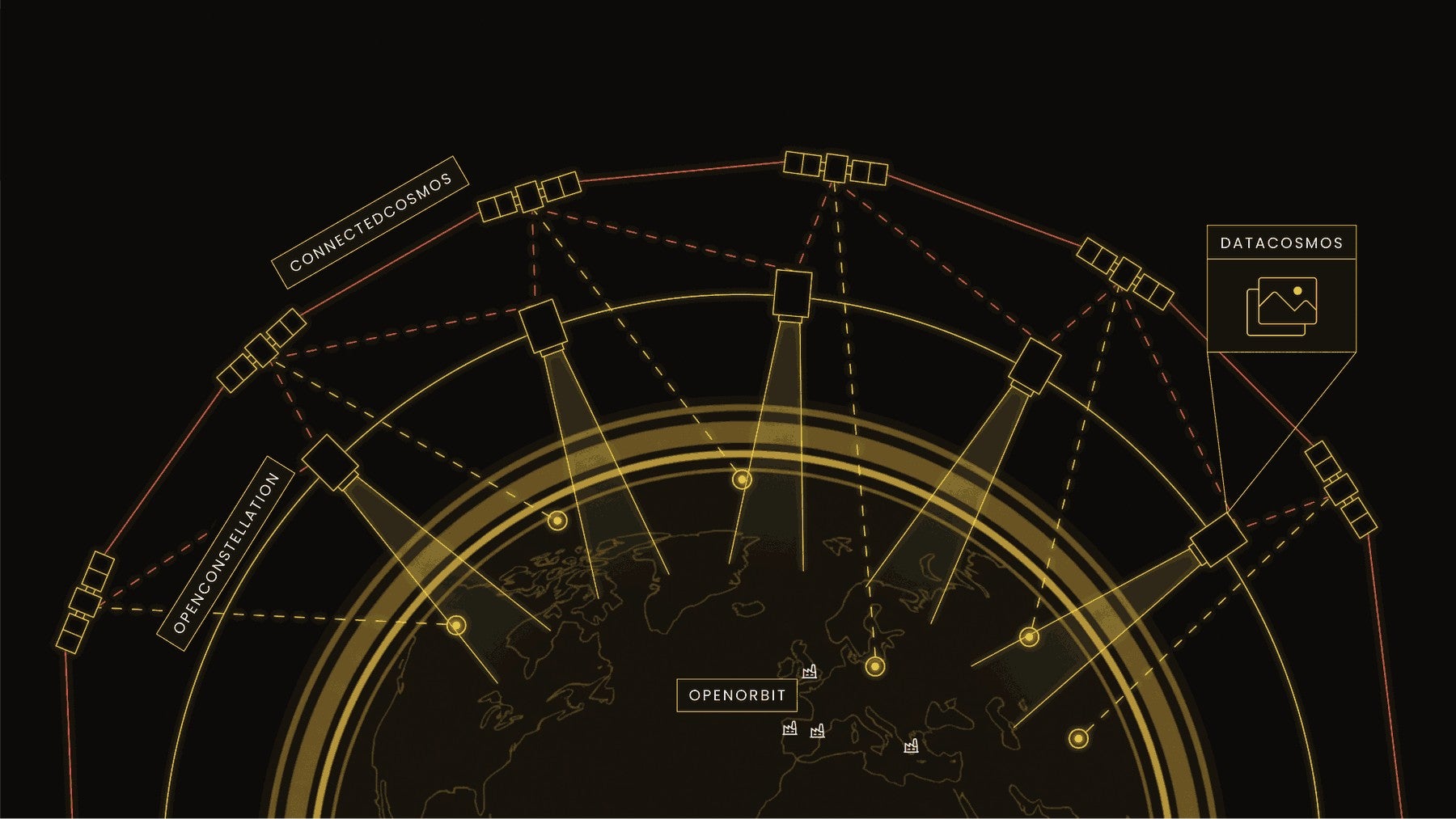
A diagram of the ConnectedCosmos and Open Cosmos constellations. Photo: Open Cosmos
Pan-European connectivity provider Open Cosmos announced ConnectedCosmos on Monday, a name for its incipient Low-Earth Orbit (LEO) constellation designed as a sovereign connectivity backbone for European governments and companies.
In a statement, the company said ConnectedCosmos will use optical inter-satellite links to create what it calls a gatewayless sovereign space mesh. The constellation’s capabilities, it said, will include point-to-point broadband and direct-to-device (D2D) Internet of Things (IoT).
The constellation will operate in Liechtenstein’s high-priority Ka-band spectrum filings, which its government awarded Open Cosmos the rights to in January. The filings are a key geopolitical asset for Europe.
“ConnectedCosmos represents a leap forward for Europe in building a resilient, secure and autonomous connectivity capability – giving nations and partners a reliable alternative for true sovereignty in orbit,” Open Cosmos Founder and CEO Rafel Jordà Siquier said.
“In a world where infrastructure can be disrupted, jammed, or compromised, our constellation ensures that critical data remains secure, trusted, and immediately usable,” he continued. “With ConnectedCosmos, we are delivering to the world an alternative that matches technological excellence with strategic autonomy.”
OpenCosmos engaged Rocket Lab to launch the constellation’s first two satellites on Jan. 22, less than a week after the company announced it had secured the Ka-band filings.
The company noted that ConnectedCosmos will also connect with its Earth Observation (EO) capabilities deployed in the Open Constellation. The company already has standing agreements to provide Greece and Spain with national Earth Observation satellites.
Siquier told Via Satellite in January that he expects commercial interest from governments, telecom operators, and large corporations, noting automotive connectivity as a potential market.
Open Cosmos operates manufacturing facilities in the U.K., Spain, Portugal, and Greece. In the statement, the company said it would launch more satellites and announce new partnerships throughout 2026.
Stay connected and get ahead with the leading source of industry intel!
Subscribe Now