Latest News
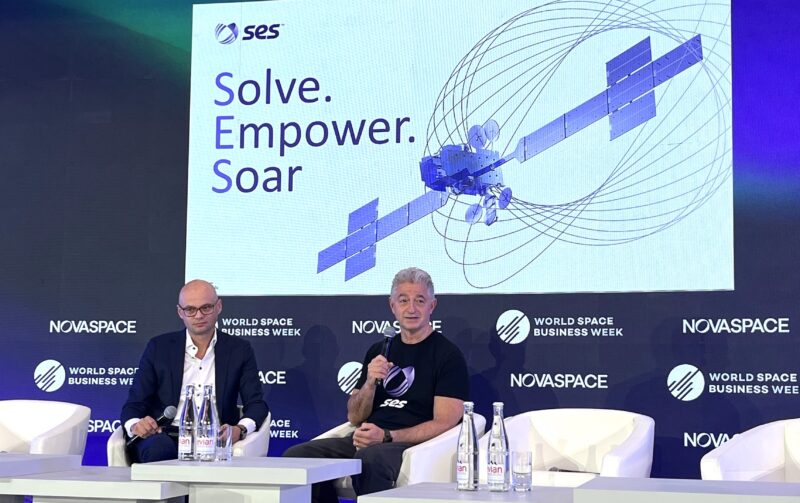
SES CEO Adel Al-Saleh, right, at World Space Business Week on Sept. 16. Photo: Via Satellite
PARIS — SES will take an agile, iterative approach to building the next-generation of its Medium-Earth Orbit (MEO) network, including a new partnership with satellite manufacturing startup K2 Space, CEO Adel Al-Saleh said Tuesday during World Space Business Week.
“We no longer look at a constellation by constellation, a satellite by satellite approach. That is not how we should be building our networks,” Al-Saleh said. “We look at it as one network we’re building, no longer islands of constellations or islands of satellites.”
The resulting network will be called “meoSphere” — a network-of-networks concept marrying together existing assets, the IRIS² constellation, and next-generation satellite in a software-defined, flexible platform. He described the change as a shift away from five-year development cycles with large CapEx spend in favor of launching new technologies every year.
As part of this, SES announced a strategic collaboration with K2 Space for development of the MEO network. The operator pointed to the K2 Space’s agile engineering capabilities to “co-develop future network infrastructure and technologies.” This agility mindset was “desperately needed,” he said.
Al-Saleh said SES plans for multiple pathfinder missions with K2 Space to test new technologies on orbit over 2026 and 2027, with the first one slated for the first quarter of 2026. These pathfinders will test multiple orbits and multiple altitudes to see how the software-defined payload behaves at different altitudes. He did not confirm a specific number of pathfinder missions.
“That’s a different approach than what we’ve done in the past. We’ve never done that before. We would wait five years to develop a satellite to put it in space,” he said. “We’re going to do it a little bit differently this time. We’re going to send components that we feel are ready to be tested, and we are going to do multiple pathfinder missions before we come to the end design of a satellite that we’ll be launching.”
SES will continue to work with existing partners in this iterative approach, along with K2 Space and other partners like the one recently announced with optical technology developer Cailabs.
“This approach gives us the flexibility to be able to react to the market, to be able to bring new technologies faster,” Al-Saleh said. “[It gives us the ability] to adjust both from a volume point of view, how much do we need to build and launch every year, as well as how much do you invest depending on what the market needs. This approach requires different thinking.”
New Brand Identity
Now two months out from closing the acquisition of Intelsat, SES is also rolling out a new brand identity this week with the purpose statement, “Space to Make a Difference.” SES is retiring the Intelsat brand, unified under the combined company.
“We’re bringing two legacy players together, we certainly don’t want to be viewed as another bigger legacy player. So we created a brand that would represent what we want to be — a new company with a modern feel and look with agility. We’re very, very proud of it,” Al-Saleh said.
Post-acquisition, SES has been working to integrate the two satellite networks and product portfolios, and Al-Saleh mentioned upcoming decisions on product portfolios. He said SES has also eliminated the need for several additional satellites through the combined fleet.
SES had been preparing for this integration for 14 months during the acquisition, and is making progress on that integration.
“Now the real hard work starts, which is making it happen. There are many different synergies that we’re working on, but first of all is to create the new company,” Al-Saleh said. “Our focus is — How do we integrate? How do we create the right structures and the right teams? How do we make sure that teams work together and drive the company forward? That’s been hard.”
Stay connected and get ahead with the leading source of industry intel!
Subscribe Now