Latest News
AscendArc Lands First GEO Order from KT SAT in a Bid to Lower the Barrier to Access GEO
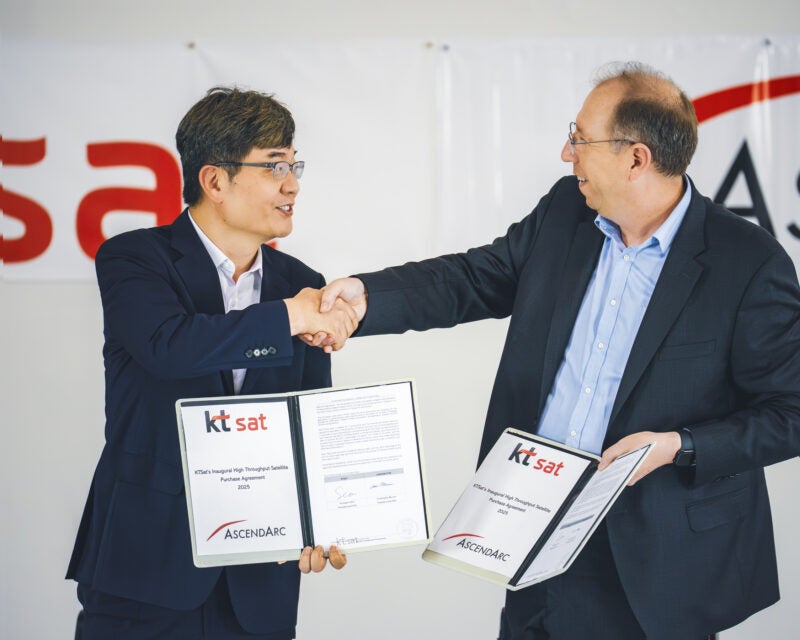
KT SAT CEO Young-soo Seo and AscendArc CEO Chris McLain. Photo: AscendArc
New player in the small GEO space AscendArc has sold its first satellite to KT SAT, the satellite arm of Korea Telecom. AscendArc announced the deal on Thursday, and is targeting a rapid timeline for development — expecting to launch the satellite in 2027.
The company is looking to lower the barrier to entry for owning a Geostationary Orbit (GEO) satellite, with CEO Chris McLain telling Via Satellite the company can offer a cost per megabit per second, cheaper than any other GEO satellites, and Low-Earth Orbit (LEO) competitors as well.
McLain is an industry veteran who has worked on high throughput satellite networks for traditional aerospace companies like Boeing, Lockheed Martin and Panasonic. He also spent a stint as an engineer at SpaceX. He founded AscendArc in 2023 to bring together the efficiency and optimization of GEO designs with cheaper manufacturing lessons from SpaceX, like using an assembly-line production model.
“I saw how you build satellites very cheaply, and thought that we could bring that [mindset of] building a satellite like a piece of consumer electronics into the Geostationary space,” McLain said. “We could get the best of both worlds — a satellite that was both very capable and very efficient … but also very cost effective, opening up the market to folks that couldn’t previously afford a satellite.”
The company emerged from stealth in January with a $4 million seed round and is currently raising its Series A.
McLain said AscendArc has developed unique payload technology that uses a large antenna and an all solid-state, software-defined payload to provide a large number of sellable megabits per second at a relatively small number of kilograms in weight and kilowatts of power. He describes the satellite design as on the larger end for a small GEO satellite, up to 1,000 kilograms.
“We are unique in that we have a price point that is like a small GEO, but we have a capability that’s more like a large GEO — something like Space Inspire from Thales, or Jupiter from a traditional manufacturer,” he says. “We can compete with the big guys on capability and have a price point that’s a relatively low entry point so that we’re affordable to any telco, operator, or MoD.”
For KT SAT, the goal for the satellite is to significantly lower the cost of internet access across the Asia-Pacific region and “dramatically” expand access where hundreds of millions of people remain unconnected. KT SAT is expanding its footprint in Asia and aims to become a global satellite communications leader. The operator said this satellite will serve as the “cornerstone” of that regional expansion.
“Access to the internet has become a critical component of economic advancement, so our poorest citizens who are without it are simply being left behind. The cost of terrestrial fiber solutions has stagnated, and so there is too often a negative return on investment to deliver access to more remote or poor regions,” KT SAT CEO Young-soo Seo said in a release.
“While some recent new satellite options have helped, they simply do not lower the cost enough to penetrate as far as needed. AscendArc stood out for its cost-efficiency, flexibility, and scalability,” he added.
Bridging the digital divide is part of AscendArc’s ambition, McLain said. “We would like to be able to get to a point where we can offer a satellite connection outside of a city or outside of an urban area, at the kind of price point that we don’t really associate with hooking up to fiber that’s running down your street — very low cost per megabit per second,” he said. “Enabling very low cost terminals is a part of that long term vision.”
He said the company is in discussions with other potential customers. It has a focus on the defense market as well, both for the U.S. government and international governments that want sovereign control of space assets within their country. The company has received more than $1.8 million in Small Business Innovation Research (SBIR) and Small Business Technology Transfer (STTR) funds from the U.S. government focused on rapidly deployable GEO communications.
Stay connected and get ahead with the leading source of industry intel!
Subscribe Now