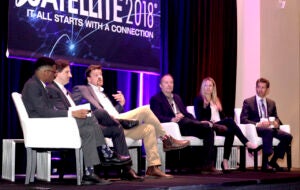

As satellite operators expand their footprints into new verticals and customer bases, the key to long-term sustainability will be integration with the broader telecommunications ecosystem. During the Tuesday opening session at the SATELLITE 2018 Conference & Exhibition, the executive leaders of five of the largest global satellite operators agreed that the future of wireless communications will be multi-faceted — with satellite and terrestrial networks operating seamlessly side-by-side within a range of markets.
Rodolphe Belmer, CEO of Eutelsat, said the next stage of transformation for his company will include major partnerships with big telcos. “We were an industry based on silo benefits — TV, government service, large quantities of data for companies operating in remote areas — and now we’re moving to position ourselves as a complement to telecommunications companies,” he said.

Explore the Show Daily 2018 Day 3 Issue
Check out more from this issue and find your next story to read.
Intelsat CEO Stephen Spengler noted that satellite naturally complements other wireless technologies due to its ubiquity, security, quality of service, and point-to-multipoint capabilities. “On top of that, with the massive investment and innovation we’ve seen in recent years, we’ve made tremendous strides in terms of the performance and economics of our services,” Spengler said.
Passengers riding in connected cars or streaming Netflix on a plane don’t care whether they’re using satellite or some other connectivity source — they only want it to be “indistinguishable from the other network elements that they use,” said Telesat CEO Daniel Goldberg. “We’re going to have a much more hybrid, integrated architecture in the future,” Goldberg said.
Mark Dankberg, CEO of Viasat, said he expects to see increasing demand for higher data rates from more miniaturized terminals. “One of the things that’s most obvious here is we need to make really small antennas to go on these platforms,” he said.
SES’ new CEO Steve Collar warned: “The most important thing for all of us is to really understand what the source of demand is. If we don’t understand what’s going on with the end users — with the customers whose demand we’re filling — shame on us.”
Belmer noted that he is quite positive about the video segment for satellite. “The revenues are very robust and the profitability is good. When we look at the penetration of the service among households in the world, it’s growing everywhere but the U.S., meaning we are sitting on a very solid, predictable business,” he said.
“You can’t downplay the demand. We all feel there are tremendous opportunities to unlock if we get the formula right,” Spengler said. VS