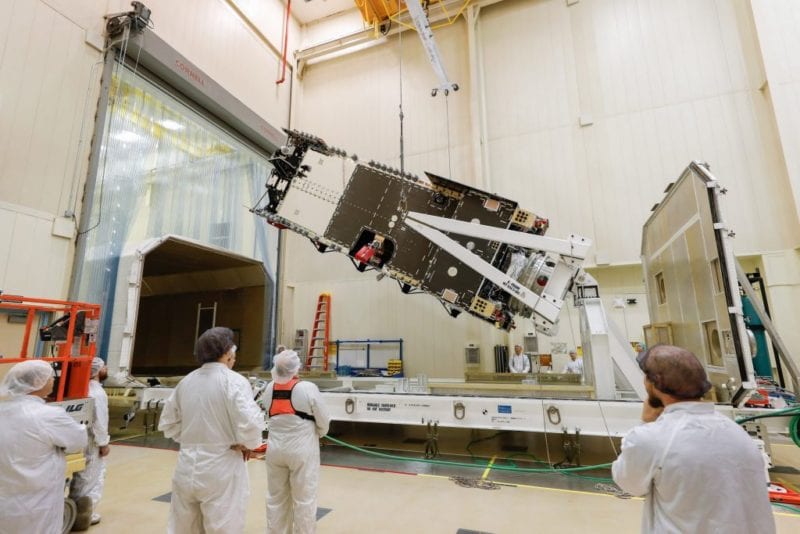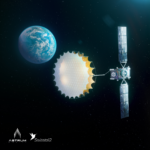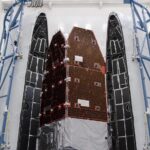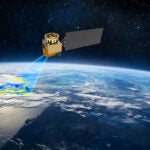

Viasat’s third ViaSat-3 satellite (F3) has officially entered service over the Asia-Pacific region, the operator confirmed Monday.
The F3 satellite will add 1 terabit per second of capacity to Viasat’s network. It is designed to “maximize regional capacity density on demand within premium mobility markets,” Viasat CEO Mark Dankberg said.
“Asia-Pacific presents a unique challenge for satellite connectivity, with demand concentrated in specific corridors and markets across a vast geography. ViaSat-3 F3 gives us the flexibility to direct high operating leverage capacity where demand and opportunity are greatest,” Dankberg said.
He recently told investors that aviation and government are the fastest-growing mobility markets and the top areas for revenue growth after the F2 and F3 satellites come online. Both are growing from a combination of more bandwidth use per platform and more platforms.
The F3 satellite launched in late April on a SpaceX Falcon Heavy mission.
Although this satellite is F3, it is the second of the trio to enter service. Viasat said the remaining satellite, F2, “is in the final stages of in-orbit testing and expected to enter service soon.” F2 launched in November of last year.
Both the F2 and F3 satellites are highly anticipated after the first ViaSat-3 satellite suffered an anomaly with its antenna deployment in 2023. That satellite is operational, but only delivering a fraction of the capacity that was expected.