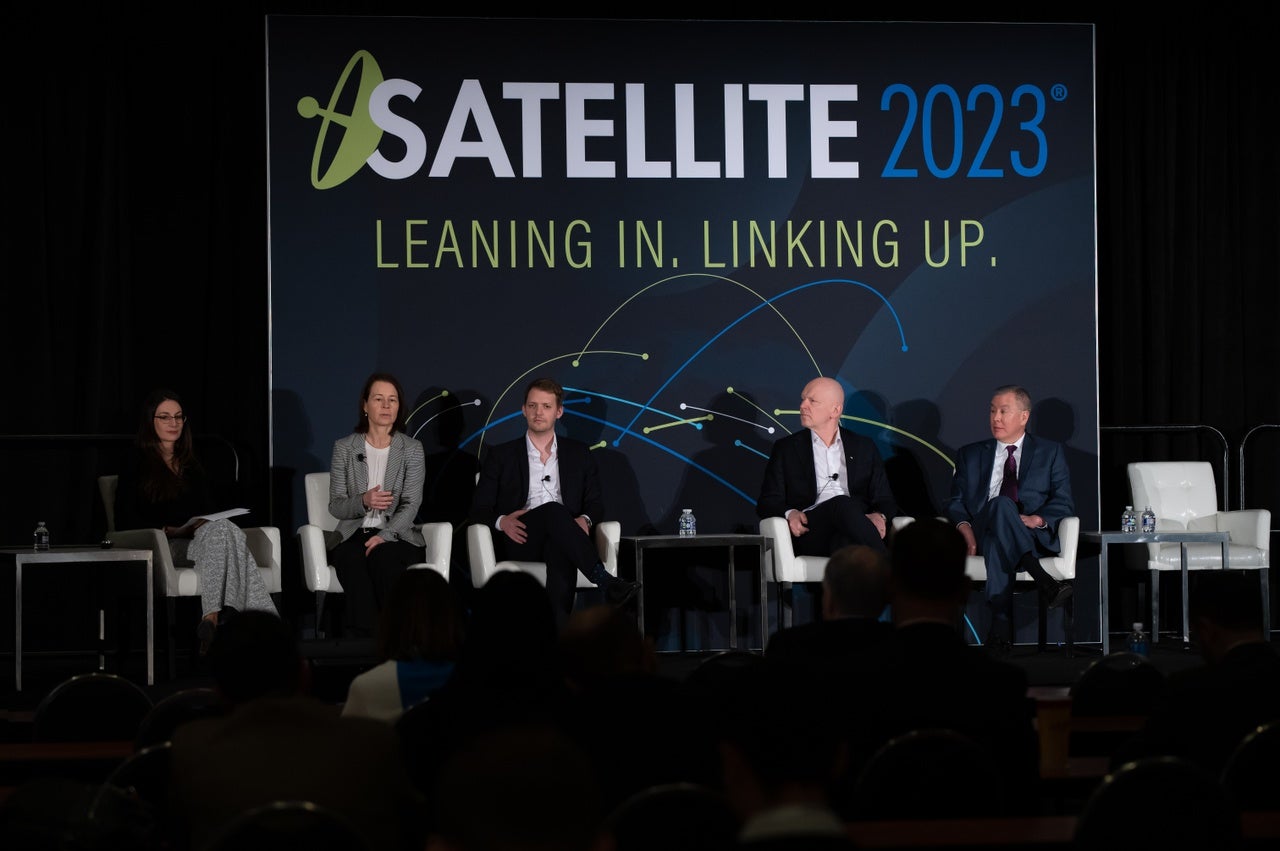

Smallsat launch providers at SATELLITE 2023 highlighted enormous pent-up demand — but also industrialization challenges, launchpad constraints, and supply chain issues that must be overcome.
John Rood, CEO of Momentus, described a dual megatrend: “The cost per kilogram to go to space has never been lower — down 95 percent over 20 years. And the amount of computing and sensing power you can pack into a small payload has expanded exponentially.” He forecasted: “Last year there was a 33 percent increase in launches. You’re barely scratching the surface of demand.”

Explore the Show Daily 2023 Day 4 Issue
Check out more from this issue and find your next story to read.
Tiphaine Louradour of Spaceflight Inc. said the company launched 20 rideshare missions on five vehicles across three continents in two years. Daniel Metzler of German startup Isar Aerospace said the challenge is industrialization, not engineering: “How can we automate manufacturing? How can we make it scalable?” He noted national sovereignty is also driving demand: nations “don’t want to be dependent on a single big player in a very specific element of their supply chain.”
Louradour stressed responsible debris management as a key concern and emerging market shaper. Ketil Olsen of Norway’s Andøya Space Center said the center is preparing to accommodate three or four launch partners as it targets the smallsat market.
On market concentration, Metzler said: “I don’t think there’s going to be 100 rocket companies commercially succeeding” — cautioning constellation customers to select launch partners who can scale with their ambitions over multiple launches per year, not just once every two years. VS