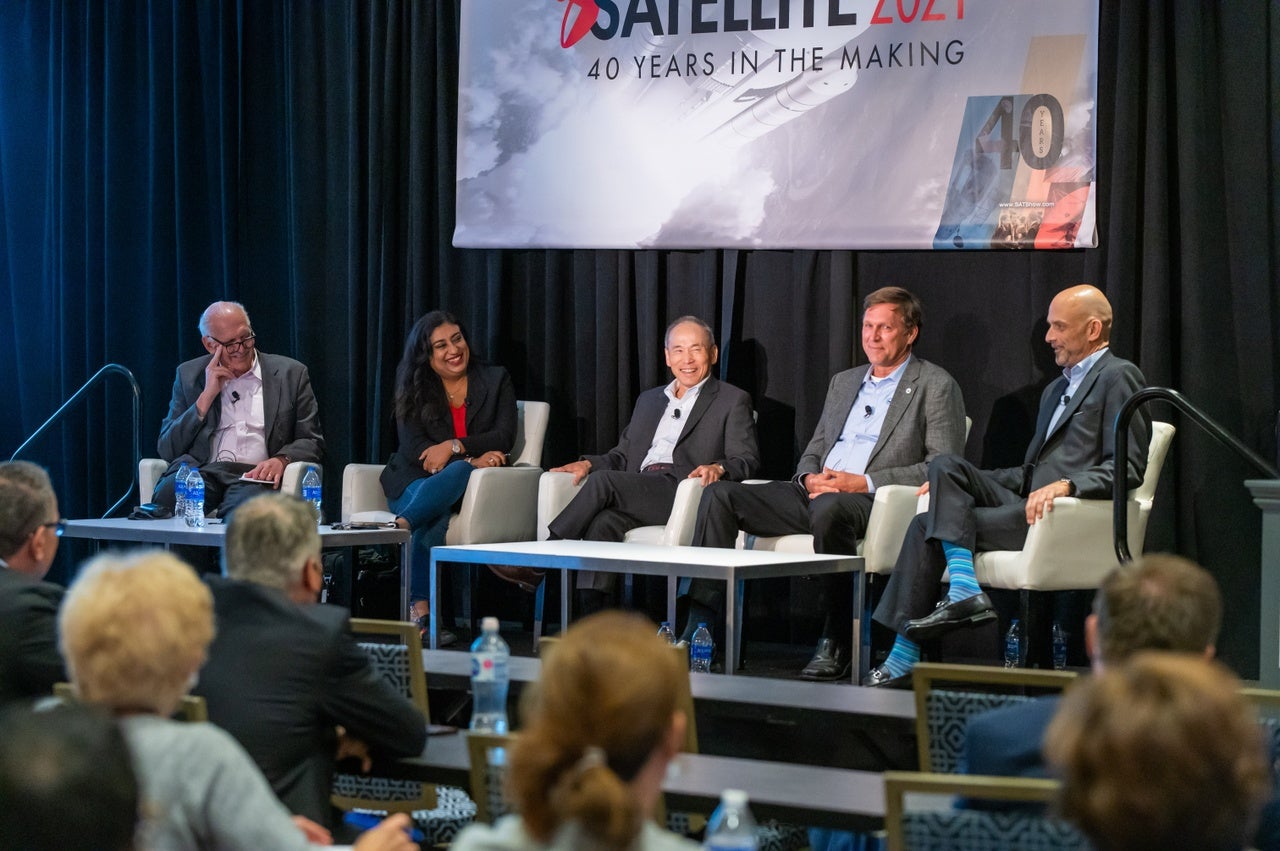

Laser communications satellites are poised to help make ultra-secure communications networks possible, executives from Mynaric, LyteLoop, Xenesis, BridgeComm, and Blue Marble Communications said at SATELLITE 2021.
Tina Ghataore, president of Mynaric USA, said security comes “inherent in the physics” of point-to-point laser transmission. Ed Berger of LyteLoop is developing storage-in-space that stores data on the photons of light on inter-satellite laser links. “It’s a lot easier to hack a network on the ground than in space. It’s very important for us to have highly secure networks, and the optical networks lend themselves more to that than RF does.”

Explore the Show Daily 2021 Wrap Up Issue
Check out more from this issue and find your next story to read.
Mark LaPenna, CEO of Xenesis, said optical is simply another layer, not a replacement for RF: “It’s about accentuating it and adding a layer to it.” Costs are falling — his satellite cost went from $18 million to $10 million in three years, a 60 percent decline. “When we designed our first satellite, the total cost was $18 million. The majority of that cost was optical heads and the internal switches.”
Barry Matsumori, CEO of BridgeComm, compared laser communications’ growth to the cellphone industry: “The cellphone that you have in your pocket now is ultra-optimized. There is so much room for technology growth.” Neal Nicholson of Blue Marble Communications said the DoD moved from 300 Mbps to 1 Gbps enthusiasm, with 100 Gbps ready and waiting for the market to demand it.
LaPenna concluded: “We are actually an industry now. This is not a group of ragtag unfunded hopefuls. We are all mature business people who understand what the market opportunity is. Now we are forming business partnerships and forming coalitions and joint venture agreements. That is really what it is all about.” VS