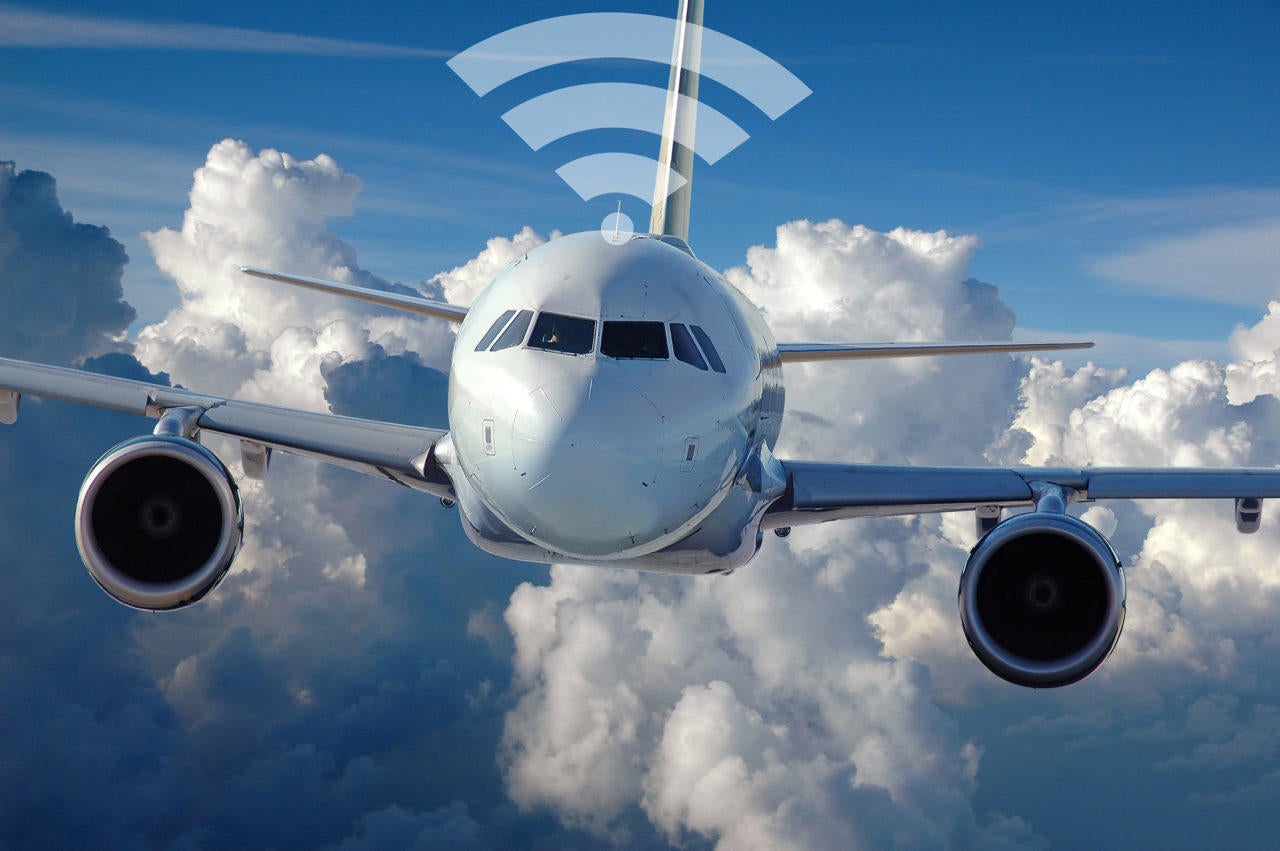
At SATELLITE 2018, connectivity service providers reset the pulse of the global aircraft in-flight internet industry with a discussion on cost structures, business models, hybrid networks, electronically steered antennas and next-generation airplane connectivity.
Mike Pigott, vice president of Global Eagle Entertainment, told the audience about the C-Suite pressure from social media backlash: “The C-Suite is seeing the impact from social media and the feedback from customers, and now they’re starting to see that impact their net promoter score and that is really driving performance out of all us.”

Explore the Show Daily 2018 Day 4 Issue
Check out more from this issue and find your next story to read.
Anand Chari, CTO for Gogo, stressed a technology-agnostic approach: “There are three words that summarize Gogo’s position. We’re multi-band — that’s Ku, Ka and anything else, L-band included. Multi-constellation — that’s LEO, MEO, GEO, and multi-mode, satellite and air-to-ground. We think there is room for all of this over the next five years.”
Gogo is investing in an electronically steered antenna with no moving parts operating within the 2.4 GHz band, and preparing to deploy next-generation air-to-ground service in North America.
Bill Milroy, CTO at ThinKom Solutions, spoke about antenna performance improvements. “The most bitz per hertz: that’s just part of the solution for getting more bandwidth on the satellites.”
Todd Hill, senior director of global satellite capacity planning for Panasonic, summed up the challenge: “We’re always trying to get like the coffee shop, you don’t quite get your home environment at the coffee shop, a little bit difficult in the middle of the ocean moving along at 700 mph. But we’re trying to meet the couch.” VS