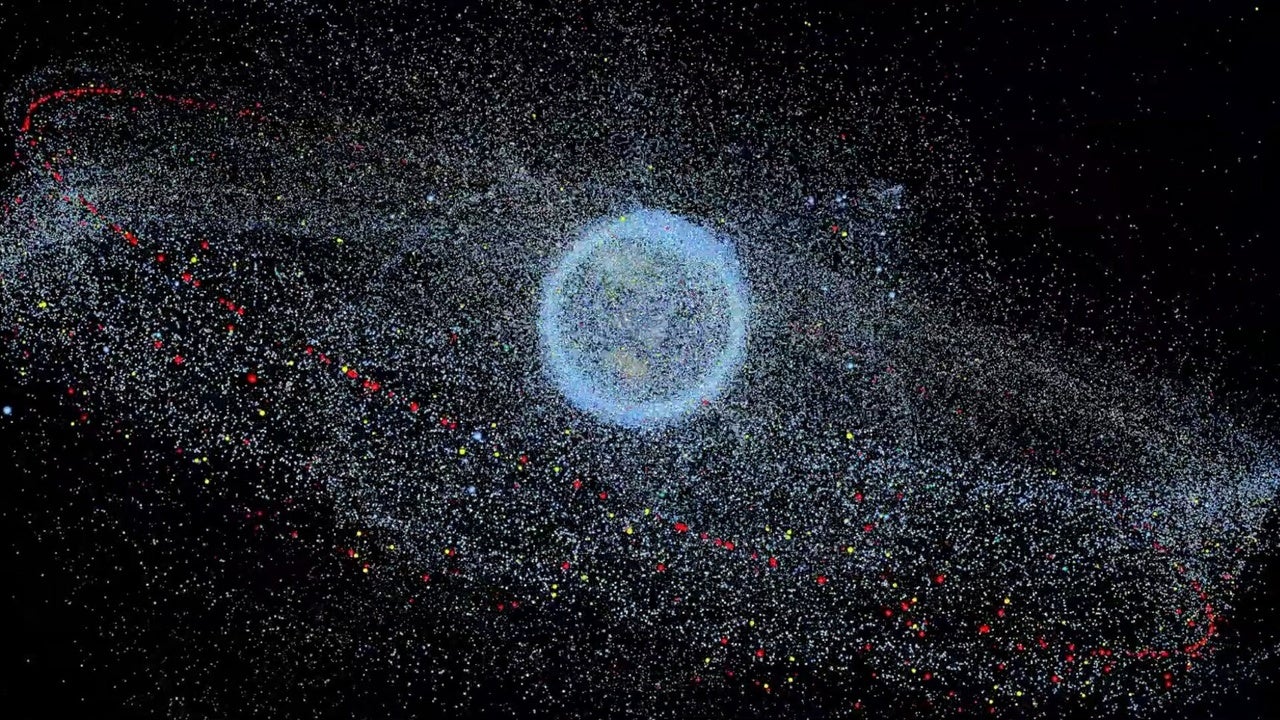
Across the industry, we’re seeing deeper commitments to sustainability — from investing in space debris removal to installing new technology to enable cleaner missions. SATELLITE 2022 will feature more panel sessions on sustainability topics than ever before.
John Janka, Viasat’s chief officer of Global Government Affairs & Regulatory, said: “There’s a growing recognition that there’s a looming crisis, and we need to act now, and we need to act at the national level. That recognition exists with a large number of satellite operators.”
Explore the Show Daily 2022 Day 1 Issue
Check out more from this issue and find your next story to read.
Ruth Pritchard-Kelly of OneWeb noted that technology is “really snowballing. Today ClearSpace, Astroscale, LeoLabs, and others expect to make money out of deorbiting. This is going to be their business.” Every OneWeb satellite is equipped with a grappling fixture to enable future deorbiting. Chad Anderson of Space Capital said the most important satellite investment areas include sustainability and climate monitoring. “I think about sustainability holistically — you need the climate piece, and you also need safe and operational orbits. Reusable vehicles like Starship are the holy grail, not just in terms of environmental concerns, but in terms of sustainability.”
On the challenge of mega-constellations, Janka warned against false comfort from maneuverability: “Even the FCC acknowledged it. If you have tens of thousands of satellites, I start having millions of conjunctions over time. There are about 30,000 pieces of debris that’s 10 centimeters. But there’s a million pieces between the size of a pea and a grapefruit.” A Viasat whitepaper notes that LEO satellite collisions at altitudes of 500-600 km have consequences that persist for decades.
Al Tadros of Redwire concluded: “Sustainability is key to making space a safer place. It is the responsibility of both private companies and government to approach space with sustainability in mind.” Janka urged holistic analysis: “The one thing that concerns me is that unless we have a plan, we risk focusing on the symptoms and not the disease itself.” VS