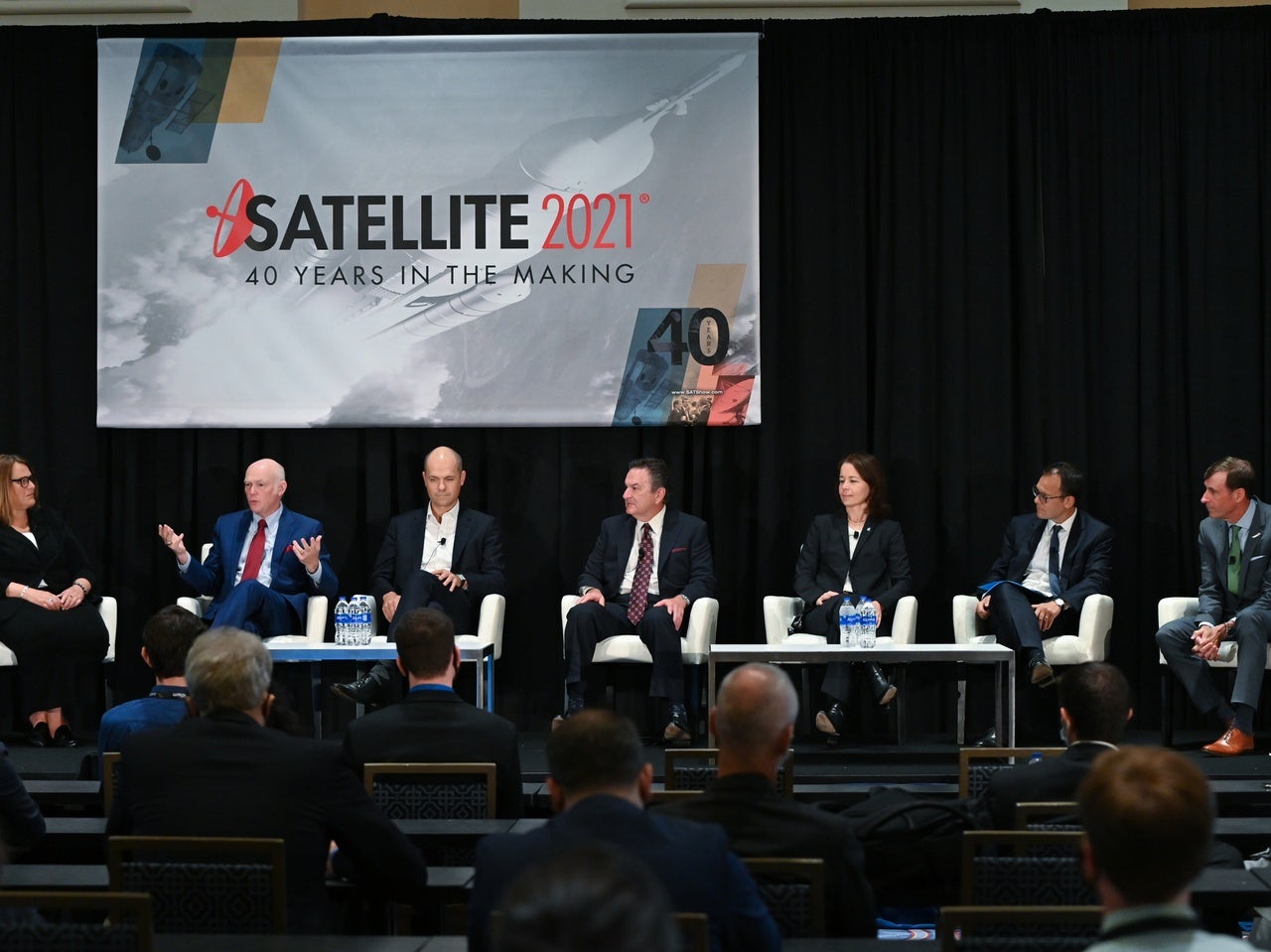

New ideas, a new focus on the consumer, and new technologies are driving growth and change in the launch segment of the space industry, speakers from leading launch providers said Thursday at SATELLITE 2021.
A new type of space logistics is coming with the expansion of space exploration, said Tory Bruno, CEO of United Launch Alliance (ULA). “When they put twice as many people in the Space Station and around the Moon, and then on the surface of the Moon, there will be a logistics train constantly going back and forth with consumables.”

Explore the Show Daily 2021 Day 4 Issue
Check out more from this issue and find your next story to read.
Josh Brost, VP of Business Development for Relativity Space, cited massive growth in investments and more rockets today than at any time in history. “On the launch side, an investor community is looking for something more capable.” Jim Simpson, chief strategy officer for Virgin Orbit, noted: “The capabilities we’re seeing now we weren’t even seeing two years ago. Now we are seeing satellites the size of a grilled cheese sandwich.”
Clay Mowry of Blue Origin forecast a wave of launch demand coming in 2024 to 2028: “There is another wave of constellation deployment coming where we will see a huge rush in launch capacity. Launch prices have come down by order of two to three.” He stressed reusability: “We need to be able to turn around and launch again and again and again.”
Bruno noted that half of the cost of constellation deployment is driven by launch. “Constellations really haven’t generated revenue yet. We are looking at the Internet of Things, with $4 trillion of activity, and talking about IoT constellations. But nobody has put a dollar into that yet.” His assessment of the market: room for three large launch providers, two small, and one air-launch. “That’s it.”
Tiphaine Louradour of International Launch Services said demand is about flexibility and performance. Customers want launch on demand, Brost agreed: “They know that their businesses are changing rapidly.” Stephane Israel, CEO of Arianespace, sees a booming future: “The dream is the capability to bring back space resources to Earth.” VS