
Amazon Web Services dived further into the space sector by establishing the AWS Aerospace and Satellite Solutions division, headed by retired U.S. Air Force Maj. Gen. Clint Crosier — credited with leading the stand-up of the U.S. Space Force.
Crosier described the “space-cloud nexus” as a natural fit: “We are going to be collecting data at such a scale that there’s no way to collect the data, process the data, disseminate, distribute, and make sense of the data without using advanced tools like Artificial Intelligence, machine learning, and advanced analytics.”
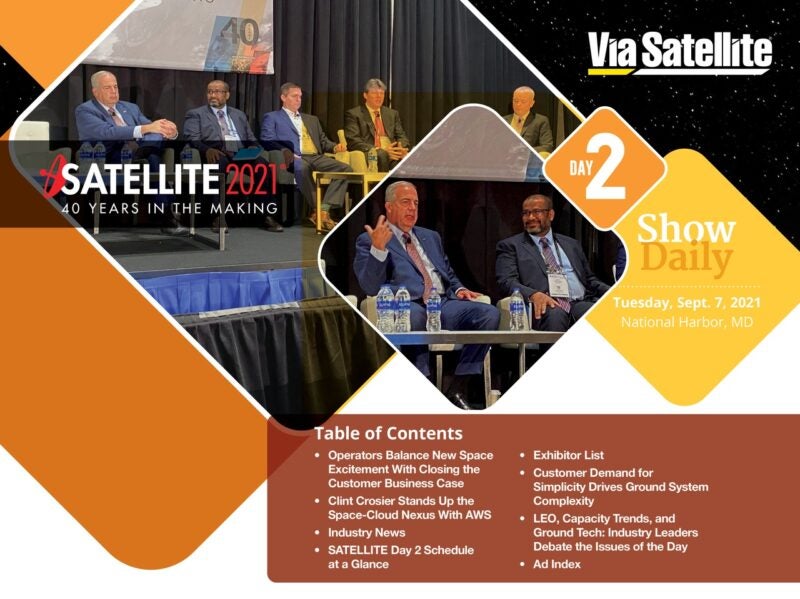
Explore the Show Daily 2021 Day 2 Issue
Check out more from this issue and find your next story to read.
On cloud adoption: “Anytime you’re changing or transforming an industry, there’s some natural hesitancy. The space industry has been relatively slow compared to the financial industry.” But AWS now holds certification for the commercial cloud from the national security and national intelligence enterprises. “We can provide better security than those companies have on their own systems.”
On their Space Accelerator program: AWS received over 190 applications from 44 countries for 10 spots. Companies like LeoLabs use AWS machine learning for space traffic management collision avoidance; Maxar does weather predictions 58 percent faster than NOAA supercomputers; and Fireball.International identifies forest fire outbreaks within three minutes of ignition.
On trends: “Artificial Intelligence, machine learning, and advanced analytics are absolute game changers in the space industry. All of those things require a greater amount of autonomy in robotics. Those are the kinds of things that you can only do on the cloud.” He sees this as just the beginning: “We’re at the very beginning, the initial days.” VS