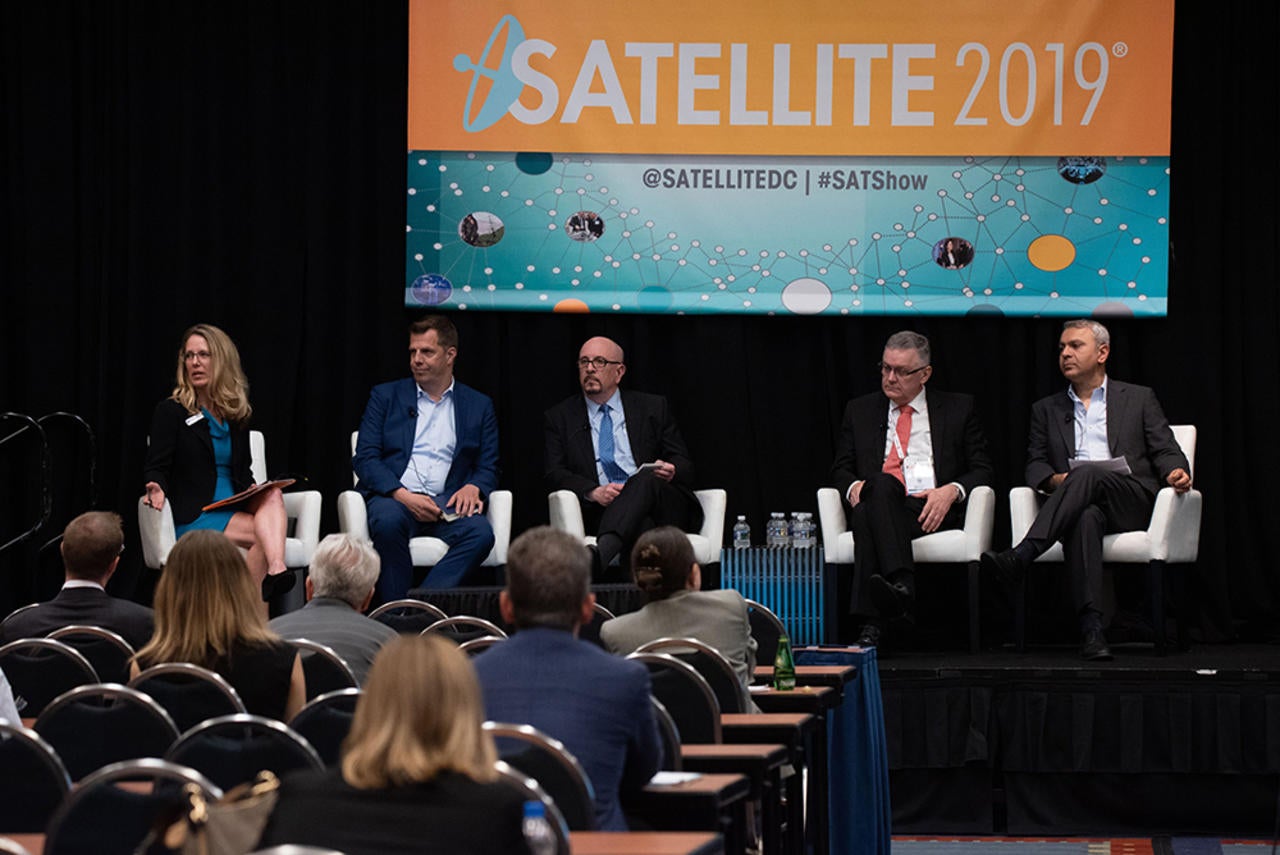

Consumers are streaming Over-the-Top (OTT) content everywhere — from cruise ships to airplane bathrooms. But how satellite will enable remote residents to watch high-definition content depends on factors like cost and business case, said panelists at Tuesday afternoon’s “OTT and Streaming Digital Media Services” session at SATELLITE 2019.
EchoStar Satellite Services GM Don Gabriel said with 5G, “there’s going to be an opportunity for satellites to play a greater role for backhaul services.” He noted satellite is becoming a more cost-effective, high-capacity solution for backhauling cell traffic: “If you’re looking down the road, that’s what you should be seeing and believing.”

Explore the Show Daily 2019 Wrap Up Issue
Check out more from this issue and find your next story to read.
Newtec’s Jo De Loor suggested hybrid solutions involving wireless, fiber, and satellite could help telecom providers expand OTT to new markets: “If you happen to live in a remote place, it’s a massive challenge. It’s going to be important to reach individuals who are less well-connected.”
AT&T’s Navid Motamed admitted telcos are heavily invested in fiber, but noted satellite could play a role: “Satellite’s role could be temporarily, a short-term functionality as they build out their network. By its nature, satellite is a cool capacity resource that can be moved around.”
SES Video VP Jurandir Pitsch countered that satellite still offers the value proposition of high-speed connectivity in places fiber can’t touch: “For the end-user consumer, they don’t care about technology. They want content, easy access.” Gabriel added: “That content still has to get out there — and maybe that justifies satellite even more. It could work for us.” VS