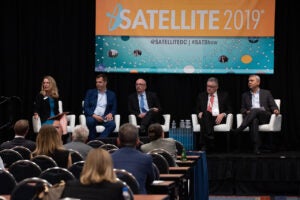

One of the most eagerly awaited panels on the final day of SATELLITE 2019 was “Antenna Technology for Advanced Connectivity Networks,” featuring antenna companies discussing the demands of the rapidly evolving market.
Panasonic Avionics’ Lisa Kuo said: “As a service provider, we feel we are best positioned to know where the market is going. All of these technologies are great, but how do you make sure all of these systems can work together? We need a lot more innovation in this area. We would like to have the same terminal forever.”

Explore the Show Daily 2019 Wrap Up Issue
Check out more from this issue and find your next story to read.
Kymeta VP Lilac Muller highlighted intercity buses as a potential new market for satellite antenna technology, noting that thousands of buses are acquired each year. “One of the things that is ignored is how these antennas are integrated into different platforms. You need to look at things in a holistic way, rather than just the cost of the antenna.”
Phasor SVP David Garood said: “Mobility will be a key business for operators. When you look at LEO, it has to be an electronically steered antenna. There is a scarcity of available solutions.”
Ball Aerospace’s Peter Moosbrugger said: “The real vector we are working on is cost. Meeting aggressive cost points is key — there are complex economic architectures and they can unravel quickly.”
NSLComm CEO Raz Ramir said satellite communication is too expensive and called for more flexibility: “We don’t know what will be needed in satellites in five to six years. We need to create flexibility for how satellites are used in space.” VS