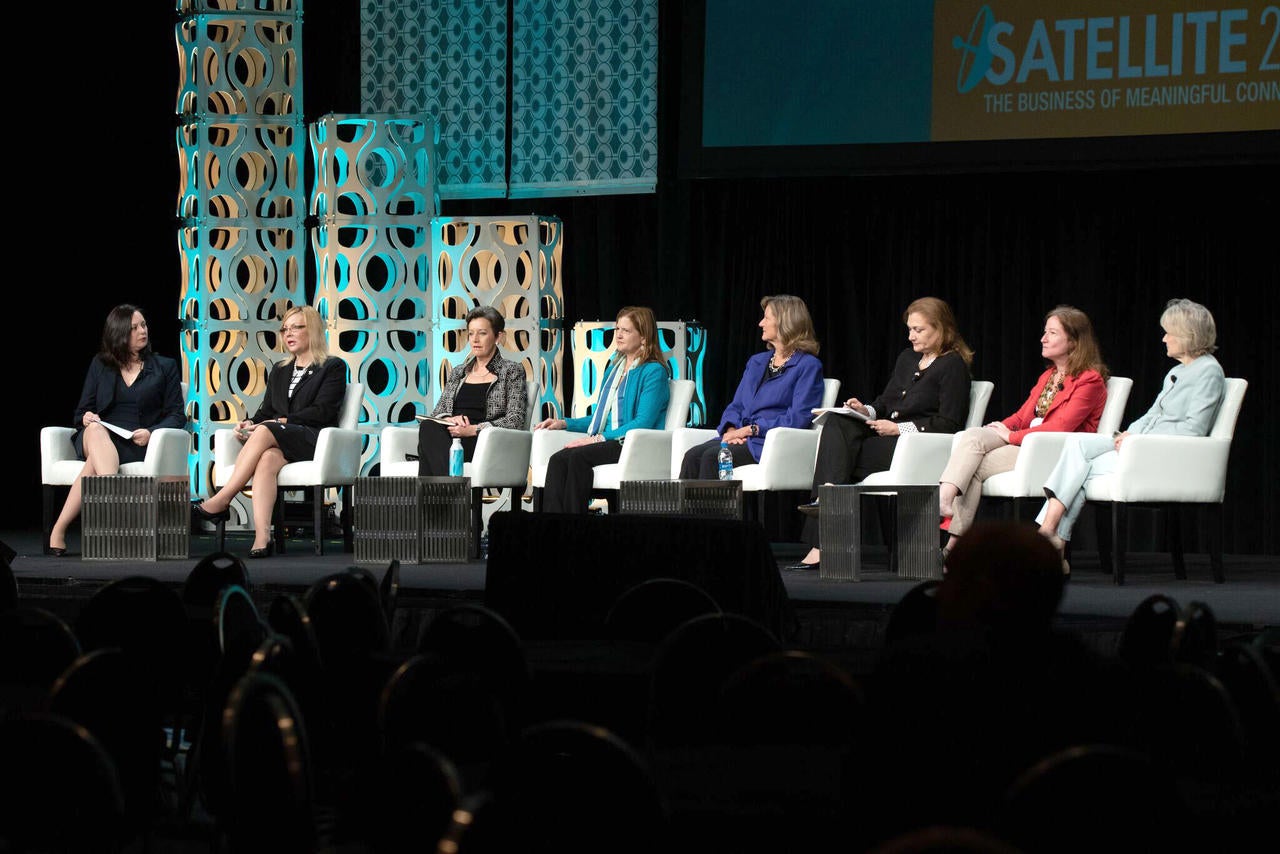

Being the only woman in a room of scientists, engineers, and business professionals is nothing new to many women in the aerospace industry. And for the eight female industry leaders who led Wednesday morning’s general session, “Our Collective Role in Empowering Women and Cultivating Diversity in Aerospace,” at SATELLITE 2019, this reality is both something to celebrate and something that needs to change.
Rebecca Cowen-Hirsch, SVP of government policy and strategy at Inmarsat Government, recalled leaving her first name off her resume when she began looking for engineering jobs after college. “When I started in college, in electrical engineering, women made up 3 percent,” said Cowen-Hirsch. “People were surprised when I went for interviews and a woman walked in.”

Explore the Show Daily 2019 Day 4 Issue
Check out more from this issue and find your next story to read.
Ball Aerospace VP Debra Facktor said she nearly missed an important opportunity to engage in high-level talks with Russia’s leading scientists in the 1990s. “I found the common language for us was engineering,” she said. “When you know math and science, whether you’re young or old or a woman or not, you have another language to speak to bridge the barriers.”
When Kay Koplovitz founded USA Network in 1977, she became a recognized industry leader. Over time, as more women entered aerospace, Koplovitz became acutely aware of barriers female entrepreneurs faced in securing funding. Today, she noted, 82 percent of startups she helped fund are in business today.
As Via Satellite Executive Editor Jeffrey Hill noted, in 2009 fewer than a dozen women spoke at the SATELLITE Show. Today, in 2019, it’s hard to find a session without at least one female speaker, moderator, or industry thought-leader present.
Yet the aerospace industry still has a way to go: just 21 percent of women earned engineering degrees in 2017, only 15 percent in mechanical engineering and space engineering, and women make 87 cents for every $1 a male engineer makes. VS