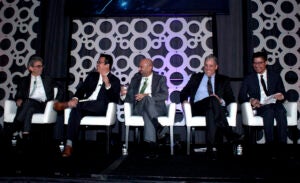

The panel “How Satellite Startups are Capturing New B2C Enterprise Verticals” at SATELLITE 2018 brought together a diverse range of speakers to discuss the issues facing satellite start-ups. Moderator Craig Mullett, president of the Branison Group, highlighted AI as a key influence yet to arrive in the satellite sector. “I haven’t heard a lot about AI at SATELLITE. We haven’t seen enough of this in the satellite sector,” he said.
Jeff Matthews, specialist leader at Deloitte, said the industry has reached a convergence of trends. “Funding rounds are being closed. New entrants are exiting stealth mode. For us, we see one of the big drivers is the democratization of data. I think where we see the most value is still probably imaging.” Matthews pointed to medical technologies as a vertical to watch for space startups.
Explore the Show Daily 2018 Wrap Up Issue
Check out more from this issue and find your next story to read.
On AI, Matthews said it could be “very transformative” to the space industry but cautioned: “An area we don’t talk about enough is the cyber implications [on space-based start-ups]. We, as an industry, aren’t addressing cyber in the way we should.”
David Shaw, CCO of Astrapi, said: “Two thirds of the world’s population does not have broadband. There is a massive opportunity for satellite operators.” He also challenged the industry’s HTS focus: “Everyone is speaking about high throughput, but there are a lot of low throughput uses as well.”
Naomi Kurahara, CEO of Infostellar, described the startup mentality: “As a new space start-up, if we can’t change the world in five to 10 years, we will die. We have to get revenues. We need to reach the service phase as soon as possible.” VS