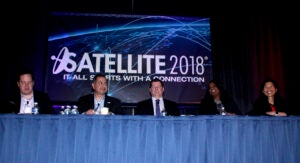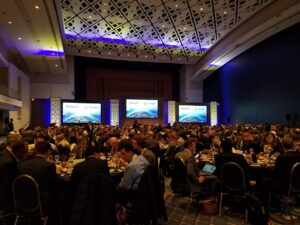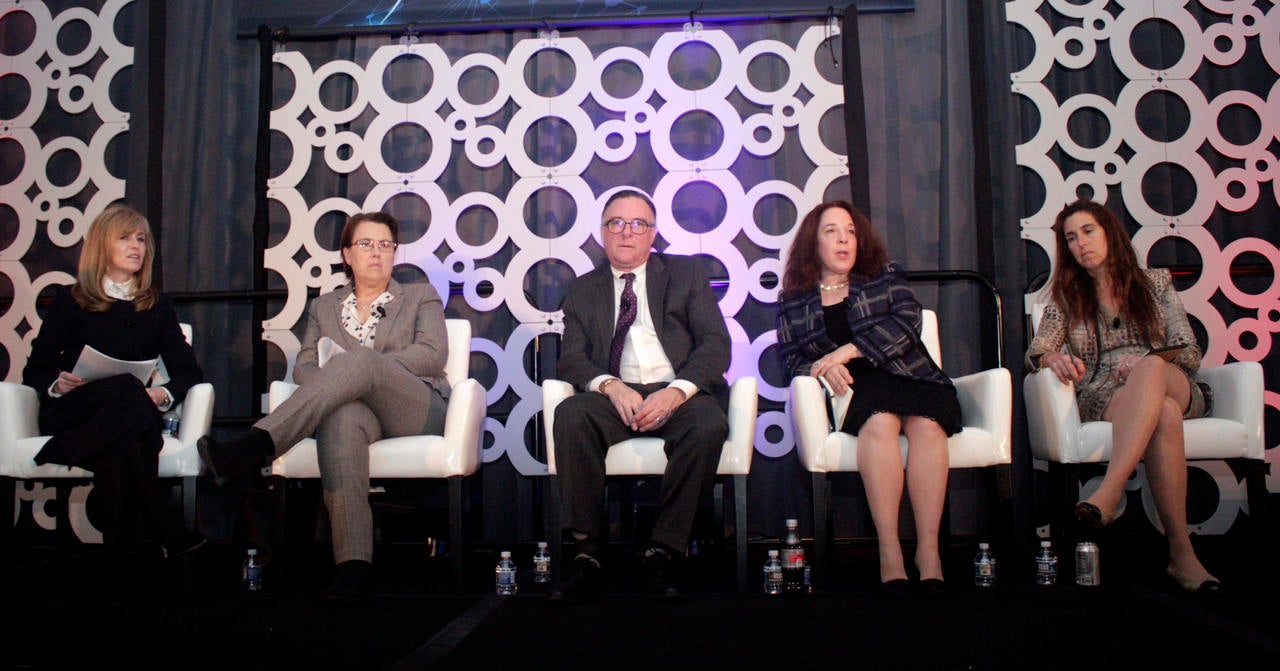

Establishing a comprehensive international space traffic regime is critical to unlocking the value of the future space economy, agreed a panel of regulatory experts at SATELLITE 2018. Morgan Stanley analysts estimated the space industry will grow from $350 billion today to more than $1 trillion by 2040.
Jennifer Warren, vice president of technology policy and regulation for Lockheed Martin, said any regime must be holistic. “Space sustainability is … a number of different dimensions. All of that goes toward creating an investment environment we hope will be hospitable for not only the existing space-faring nations, but future commercial activities in more nations.”
Explore the Show Daily 2018 Wrap Up Issue
Check out more from this issue and find your next story to read.
Kenneth Hodgkins, director of space and advanced technology for the U.S. State Department, said the space community has “institutional schizophrenia.” “There are nanosatellites being launched — by India, by France — that we’re not entirely clear have been properly authorized and supervised under the Outer Space Treaty.” He said: “It’s not fair and it’s not sustainable” to have U.S. operators held to different standards than international peers.
Jennifer Manner, Echostar’s senior VP of regulatory affairs, emphasized flexibility: “We can’t sit here today and foresee every use case and application. We need to think about things that are unpredictable.”
Manner outlined three elements for a successful regime: covering all objects regardless of orbit; a dynamic, upgradable framework; and including debris mitigation, data sharing, and organizational oversight.
UNOOSA Director Simonetta di Pippo announced the upcoming Unispace+50 gathering in Vienna, which “will be a turning point in terms of being more supportive of the interests of all member states, in particular developing countries.” VS