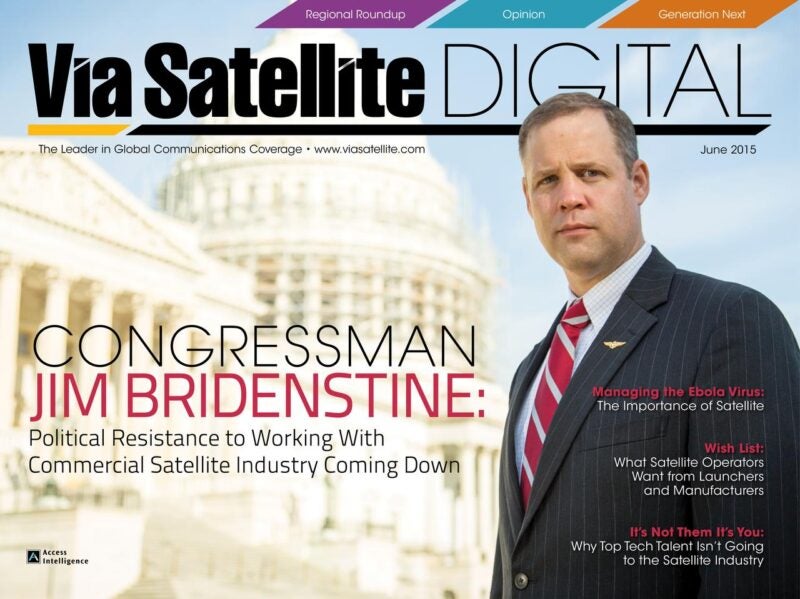

If you could have the ear of the leading satellite manufacturers, what would you say you most want them to focus on over the next few years?
Via Satellite posed that question to five satellite operators’ Chief Technology Officers (CTOs) who are leading the Research and Development (R&D) footprint for their organizations in one of the most exciting periods in the satellite industry. The collective “wish list” exercise yielded some anticipated responses on the need for flexible payloads that can be reconfigured on the fly. But many of these executives also agree on key points around innovation and what the industry needs to do as a whole to support the future business case of satellites in a fast-changing environment. One thing is clear: It’s going to be an interesting next few years to see if their wish list comes true and how the mindset and operating models of the satellite sector will evolve as a result.

Explore the June 2015 Issue
Check out more from this issue and find your next story to read.
End Game — Driving Down Cost
To Thierry Guillemin, EVP and CTO of Intelsat, the breakthrough he’s been waiting for on the satellite side mirrors what the industry has long anticipated on the launch side with reusable launchers: “the ability to get the cost of the space segment to a much lower level and help satellite be a more effective partner for ground solutions,” he says.
The answer, according to Guillemin, is digital payloads. They are the cornerstone of his company’s Intelsat EpicNG satellites, which will allow customers to connect in any bandwidth increment from any beam to any beam.

Guillemin is joined by CTOs Yohann Leroy of Eutelsat, Marcus Vilaca of Yahsat, Stewart Sanders of O3b Networks, Zoubair Kachri of Es’hailSat, and Ali Ebadi of Measat, as they elaborate on their top wish list for satellite builders at a crucial moment in the industry.
The next wave of technology and operational innovation coming on both the space and ground side could well transform the satellite sector from being viewed as expensive and slow to change to one that is agile, flexible, and affordable — and a viable broadband option to emerging economies not served or underserved by terrestrial links.
The Top 3 List

While manufacturers always are going to be tasked with delivering reliable payloads at lower cost, the three innovations these CTOs agree will give the industry its biggest boost in the coming years include:
• More flexible, intelligent payloads
• Electric propulsion systems
• Better, more affordable ground infrastructure
More Flexible Payloads
CTOs were universal in their view that flexibility is a must-have if the satellite industry hopes to be competitive to the terrestrial market.
“Flexible payloads that offer affordable, reconfigurable coverage will reduce the regulatory and market risk,” says Kachri, noting that if the market has a downturn, the coverage can be reconfigured to a geography or application that is more lucrative.
Yahsat’s Vilaca agrees, cautioning that, historically, flexible designs were developed for discreet operators without thought to scale, and this is an area that can be improved on moving forward. He cites payloads manufactured for Spaceway, Thuraya and Inmarsat 4 as examples. “All those satellites had different solutions for signal processing and additional beam forming, but they were all one-offs — you had to pay out non-recurring engineering costs and there was no added value from that. Manufacturers need to design a product that can be used by Intelsat, by Yahsat, by SES, and other operators. Hopefully this will also lead to lower cost through economies of scale for signal processing,” Vilaca says.

Guillemin says the industry has reached a turning point “where we could see fully configurable satellites in orbit become a reality in the next five years. They would be able to move power, bandwidth, connectivity, coverage as the market demands.”
That’s why Guillemin is so excited to talk about Intelsat EpicNG with its ability to concentrate the power of the spacecraft where the traffic is the most demanding. For the next phase of Intelsat EpicNG, users will be in a position to design the mission on the satellite while it’s flying, regardless of their coverage in orbit. “That means the satellites begin to look very much alike. This gives manufacturers the ability to build the same spacecraft many times over,” Guillemin says.
For O3b’s Sanders, phased array type technology, coupled with higher processing, is the manufacturing sweet spot his firm is looking for given that the Medium-Earth Orbit (MEO) satellites in O3b’s fleet need to cover multiple land masses with different requirements. The company does that today with steerable spot beams but, according to Sanders, “we could do it through phased array.” The technology, he says, has improved but the cost is not quite to the point to make a business case for its full adoption.
Overall, Sanders emphasizes that it’s about having “a better chip set, better designs, bigger volumes.” He says one source of innovation may come from the governmental side of commercial operators, which may soon release technology originally designed for government users to the commercial world. “That’s a big plus because it reduces technology risk,” he says. Intelsat EpicNG’s digital payload was spawned this way, as Boeing originally developed the technology for the U.S. Department of Defense’s Wideband Global Satcom (WGS) system.

Eutelsat’s CTO Yohann Leroy believes more flexible orbiting technologies that enable the satellite to be more reconfigurable will equate to greater competitiveness on the service provisioning side, thanks to quicker ramping up and better fill-rates over time. “That’s why we have embarked on the Eutelsat Quantum program. This satellite will be the first fully software-defined commercial satellite on the market making it entirely reconfigurable, not only in power, but also in coverage and frequency bands,” says Leroy.
Scheduled for launch in 2018, Eutelsat Quantum will serve data, mobility, and government applications and has been initiated with the support of the European Space Agency (ESA). Having ESA on board as a funder has allowed Eutelsat, to some extent, overcome what Leroy describes as the “chicken and egg problem” — that is, the commercial satellite industry’s reluctance to be the first to introduce innovation because of the non-recurring costs the early innovator must pay and that the later adopters avoid.

Electronic Propulsion Systems
Sanders says that, in addition to making advances in power consumption through phased arrays, manufacturers will get the biggest bang through improvements in electric propulsion. Both of these innovations provide greater flexibility — but at a cost.
“If you are willing to pay the extra money to go with phased arrays or electric propulsion, or some combination thereof, you are buying yourself more flexibility to serve your markets going forward. But it comes at a risk — a technical risk — additional cost.”
Eutelsat is most bullish on the merits of electric propulsion and with good reason: in July, the Paris-based operator ordered from Airbus its first all-electric satellite, outside of the two being built by Boeing for Satmex, which Eutelsat acquired. The operator launched the first of this batch of two last month.
According to Leroy, electric propulsion will be key for future High Throughput Satellite (HTS) systems — “giving us much more gigabits per second than what we have today by allowing us to get more capacity in-orbit than for a chemical propulsion satellite of the same weight.”
Ebadi agrees that electrical thrusters will become more widely deployed, but he also would like to see improved performance and efficiency during the orbit raising. “The current period of orbit raising of four to five months should be tremendously reduced to weeks or even days,” he says.
Better, More Affordable Ground Infrastructure
Of course, innovation on the payload is only half of the equation, with many industry leaders noting the degree to which ground innovation lags behind advances on payloads. “Nothing will be real for customers and consumers unless we have the right ground terminal and technologies at the right price point,” says Guillemin adding that winning systems will be the ones that bring this low-cost terminal or sensor to the consumer.
Leroy agrees, noting that the ground segment has not kept pace with innovation occurring in space. “Options for ground-based solutions are less well defined,” says the Eutelsat executive. “We are willing to get a clearer picture of the roadmap from ground-segment manufacturers.” That becomes significant as operators target the broadband market, because the cost of ground segment can represent a significant share of the overall investment, Leroy explains. He points to two areas of focus for ground players: the gateways necessary for a satellite to be connected to the Internet, and the terminal equipment, which needs to be available at a lower price in order for satellite to be competitive with terrestrial equipment over the long run.
“The scale is not the same. Satellite modems are for use in lower quantities than the terrestrial modems, for example,” says Leroy. He is optimistic that the huge opportunity for satellite broadband in emerging regions is such that the volumes can be there.
“In particular, for operators like Yahsat focused on providing consumer broadband as one of their key offerings, the need to reduce the cost of the user terminal is important,” adds Vilaca.
Both O3b and Intelsat are looking at low-cost antenna technology from Kymeta. In fact, under a new joint development program, Kymeta’s flat satellite tracking antennas will be designed to work seamlessly with Intelsat’s satellite fleet, opening up new sectors for which traditional antennas are not currently practical. “The Intelsat-Kymeta development agreement is expected to lead to a range of antenna and terminal products across our core application verticals such as maritime and aero mobility, content delivery, wireless backhaul applications and the Internet of Things,” says Guillemin.

Measat’s Ebadi points to several ground improvements manufacturers should tackle, including improving throughput, developing faster processors and higher efficiency modulation/coding. “Advances in modem technology have included the ability to adaptively code and modulate data based on the link quality, choosing link margin over capacity when the link is degraded (e.g. weather) and providing higher capacity when the link quality is good,” he says.
CTOs: Upbeat about Future
So, how would the industry look if many of these wish list items came true?
Vilaca echoes the views of other executives that, if manufacturers are able to innovate and drive prices of building payloads down, satellite will be in a strong position to serve emerging markets — especially for consumer broadband.
“As the price goes down, we are going to see high penetration in markets that were not able to afford satellite services before — such as emerging markets in Africa and the Middle East. In those emerging markets where purchase power is low and infrastructure is poor we have a solution that works,” says Vilaca.
Kachri notes that as the cost of space missions are reduced, reusability of spacecraft increases and regulatory risk will decrease. “More nations and entrepreneurs will be encouraged to enter the industry, and more competition means better products and innovation.”
Want Manufacturing Innovation? CTOs Share How We Can Get There
So, what can operators and the satellite industry as a whole do to support these manufacturing advances that could even the playing field for satellites in a terrestrial-dominant landscape, as well as lead to new markets and new business models? Here’s what the CTOs said:

Sanders: Get out of your comfort zone. Look at new business cases and be willing to spend time to close them — even if it means taking more technical risks and adopting new technologies.

Guillemin: There is no one system that will serve an abundance of users around the world. It’s all about interdependence and cooperation. We must leverage and combine multiple technologies and systems to bring the best price and value to customers.

Vilaca: Move away from customized (one-off solutions) in favor of working with existing technology solutions.

Leroy: Improve the conditions for innovation, in particular with support for non-recurring costs.

Kachri: Better standardize space units and interfaces, and coordinate lobbying efforts to direct more R&D funds to the space industry.

Ebadi: Promote more risk-sharing between satellite operators and technology partners; more incentives to the operators to use new or unproven technology; more willingness by insurance communities and underwriters to accept these types of risks; and finally, more public-private funded industry research with governmental organizations such as NASA, ESA and the Japanese Aerospace Exploration Agency (JAXA). VS
Anne Wainscott-Sargent is a communications consultant and writer who brings nearly two decades of writing experience in the aerospace, satellite, telecommunications, defense, and government sectors.